The board at the beach station says «€50 / 15 min» and «no licence required». Both lines are true, and neither means what it looks like. Fifty euro is the price of the machine, not a ticket per rider. And «no licence» is not the absence of rules: it is one specific Cypriot provision, and you sign a piece of paper under it.
- What Cypriot law counts a jet ski as, and why that reaches you
- What actually sits behind the words «no licence required»
- From what age you are allowed to drive — and who sets that number
- Why the price is per machine, and what two riders pay
- How a legally licensed beach station looks from the outside
- How far you may go, and where the rules of a place stop you
What follows is only the checkable part: the articles of the Cypriot laws, the ministry's own equipment sheet, and the prices the operators print themselves.
What Cypriot law counts a jet ski as
Cyprus has no legal category for «a water toy». It has the high speed small vessel: engine-driven, no more than 15 metres long, able to make 15 knots or more. A jet ski is a kind of that vessel, with an outboard or a water-jet drive, ridden sitting or standing by one person or several. Everything else follows from this — registration, inspection, mandatory equipment and licences.
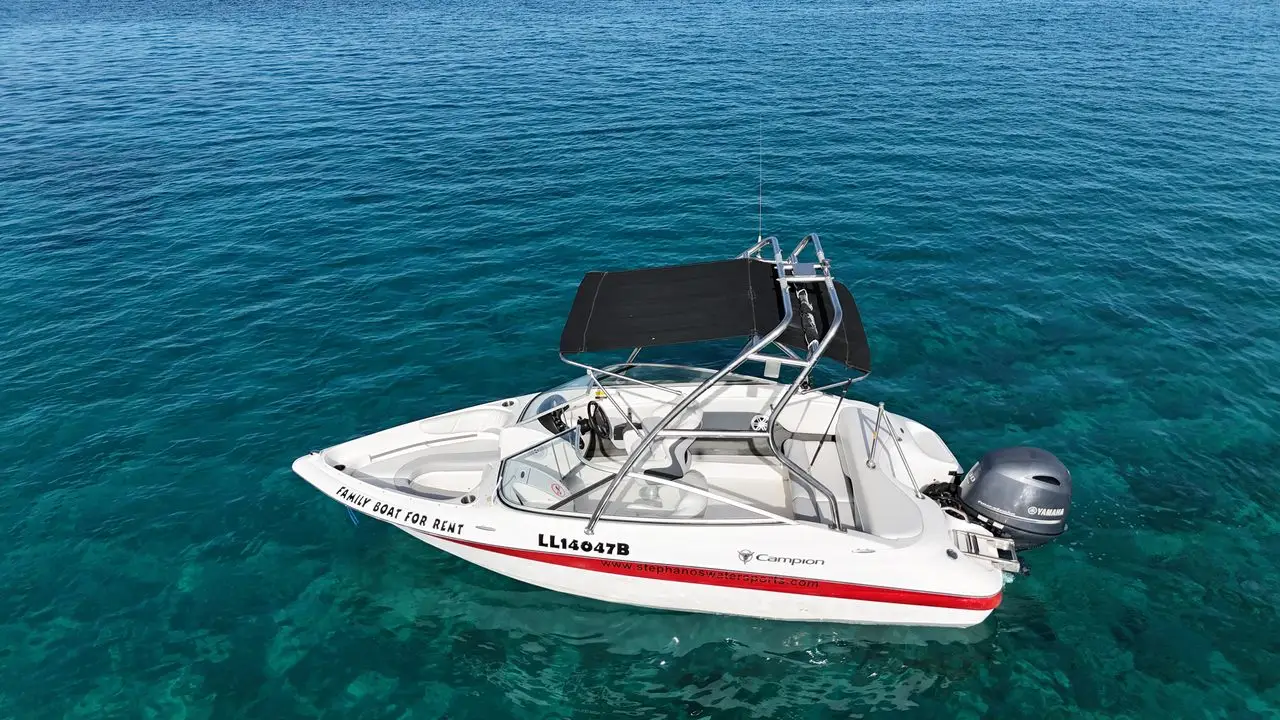
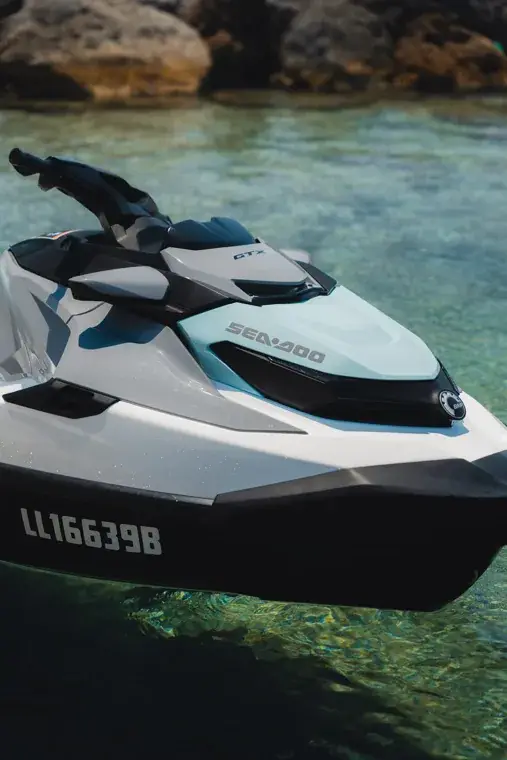
The regulation splits such vessels into two categories. A is private, for the owner's own recreation. B is public: the registered owner hands the vessel to third parties for money. Everything that stands on the beach and is rented to you is category B — and a category B hull carries the letter «B» after its registration number on the transom. That is the first thing you can check with your own eyes, without asking anyone.
«No licence required»: what is hidden behind the phrase
Licences for a high speed small vessel do exist in Cyprus, in two steps. The learner's licence starts at 17 and costs €17.09 in application fee; with it you may only drive alongside the holder of an operator's licence. The operator's licence starts at 18 and is issued only on top of a valid learner's one.
It takes a practical and a theoretical exam, both held by nautical clubs appointed by the deputy minister of shipping, which also provide the boat for the practical part, plus a medical certificate no older than six months. The fee is €76.88 — €8.54 for handling the application and €68.34 for the exam. Holders of recognised diplomas are exempt from the exams and pay only €8.54. The pass certificate is valid for three months.
Then comes the note that makes the whole page worth reading. A temporary visitor who has been in Cyprus for less than thirty days and holds none of those licences may still drive a rented high speed small vessel. One condition, and it is a hard one: they sign a binding declaration with the owner of the vessel, and the owner is obliged to satisfy himself that the visitor has the knowledge the 1999 regulations require.
Why that is not the same as «there are no rules»
The provision did not cancel the licences. It moved the responsibility onto the operator. That is where the five-minute briefing comes from, and the sheet you are handed to sign, and the staff who do not leave the water’s edge. Two conditions are yours to meet: the machine is rented, not your own, and your stay is shorter than thirty days. Baywatch writes «no licence required» on the page of its guided safari, and XS & Stephanos says the same about its self-drive boats from eighteen up — true about the way they run their rides, not a summary of the law.
Definitions, categories, the two licence steps, the fees and the note on temporary visitors: Shipping Deputy Ministry of the Republic of Cyprus, «High speed small vessels and safety requirements», read 8 September 2026. Legal base — laws 56(I)/1992 and 60(I)/1999 and regulations P.I. 121/1999.
From what age are you allowed to drive?
The numbers 17, 18 and 21 all appear in the Cypriot papers, and none of them is a minimum age for renting. Seventeen and eighteen are the two licence steps. Twenty-one is the age from which a person may apply for a beach licence — that is, run a station, not ride. The age of the customer is set by the operator, and it is his page you have to read.
Here that leaves one published number. On the guided safari from Kalamies Beach the operator states the driver must be 18, and repeats that neither a licence nor experience is required because a guide leads the group; each machine takes two people at most. The boat hire down the coast works the same way — XS & Stephanos rents its self-drive boats from eighteen up, with a briefing and basic training before departure.
The plain rental off the same beach falls outside that pattern: Baywatch publishes no minimum age for it and prints 18 only on the page of its guided safari. So there the answer is «ask at the station», not a number you can plan around.
Is the price per rider or per machine?
For the machine. The price here is set per jet ski, and one rider or two ride for the same money — which is the practical part of this whole article. Baywatch sells three slots off Kalamies Beach — 15, 20 and 30 minutes — and prices every one of them per machine.
| Where and with whom | What you buy | Price |
|---|---|---|
| Kalamies Beach, Pernera (Protaras) | A straight rental of 15, 20 or 30 minutes | €50 / €60 / €90 per machine |
| From Kalamies, guided | Cape Greco and the Blue Lagoon, one hour with a swim stop | €150 per machine solo, €200 with a second rider |
The operator does the arithmetic for you on its own pages. Baywatch writes the price out per machine and multiplies it: two jet skis for fifteen minutes are €100 and four are €200; two for thirty minutes are €180 and four are €360, with four machines the ceiling for one booking. A second rider on the same machine is not charged separately.
One line breaks the pattern, and it is worth knowing before you book. On the guided safari from Kalamies a second rider on your machine adds €50 — €150 solo against €200 for two. And that safari never goes out with a single machine: two is the minimum and four the maximum, so the smallest booking at the operator's own price list is €300.
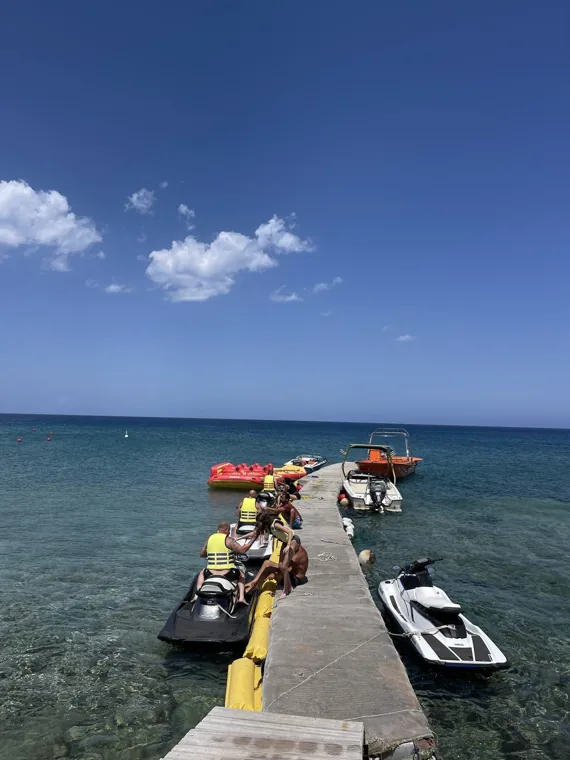
How a legal station looks from the outside
Cyprus gives a rare chance to check the seller without asking a single question, because the law tells him what to hang on the wall.
Two boards and a log book
Under section 3 of law 56(I)/1992 every such vessel must carry a board of «duties of the owner and the operator» in English and Greek. Category B carries a second one: the hire price of the vessel, again in both languages. Category B also keeps a log book of users' particulars. A price printed in two languages next to the machines is therefore not decoration but a legal requirement — and its absence is the easiest thing to notice.
Behind the boards sits paperwork you will not see but can rely on. A category B hull is inspected every year — a private one every five — and all periodic inspections are done in the first half of the year; without a valid circulation licence the vessel may not be used at all. To apply for the inspection the owner attaches a copy of the local authority's permit to use the shore. The inspection fee is €51.26 per vessel.
That shore permit is the part travellers rarely suspect. It is not a rented pitch: it is a licence for the provision of public beach facilities, awarded by the municipal or community council through a public tender under the Foreshore Protection Law (cap. 59).
The candidate must be at least 21, hold a clean criminal record, a first aid diploma and a lifeguard diploma, have five years of experience, vessels registered with the Shipping Deputy Ministry and a licence to drive a high speed vessel. That is why one beach usually has one station, and why its price list is on the wall.
Buoyancy in newtons, a kill cord and 74 decibels
The Cypriot sheet does not prescribe «a life jacket». It prescribes buoyancy in newtons, and it changes with the operating area: at least 150 N for vessels working up to 12 nautical miles offshore, at least 100 N up to six miles, and at least 50 N for a jet ski. The count is by the maximum number of people carried — other vessels add one spare.
The rest of the mandatory list for a jet ski is short and specific: an automatic engine cut-off system — the cord you clip to your wrist — a hull inspection afloat, a user manual, an engine emissions test, noise below 74 dBA at full revolutions measured from 17 metres, and marking with the hull number and the prescribed capacity. An anchor, oars, a bucket, a torch, a fire extinguisher, flares and a radio licence are not required for a jet ski, unlike for a boat.
The neighbouring line of the same sheet explains what you see over your head at the same station: the tow rope of a flying object must be shorter than 100 metres, the rope of a surface object — a banana or a ringo — shorter than 50, and a log of flying-object use is kept. None of that applies to a jet ski, but it is the same beach: the parasail at Kalamies and the one at Sunrise Beach fly on ropes measured by that rule.
Boards, log book, inspections, circulation licence and the buoyancy, kill-cord, noise and towing requirements: the official sheet «Prepare Your Boat In Accordance With The Provisions Of The High Speed Small Vessels Laws 56(I)/1992 And 60(I)/1999 And Regulations P.I 121/1999», Shipping Deputy Ministry, read 8 September 2026. Beach licence and the requirements on its holder: Business In Cyprus, the Republic's single point of contact, section «Water Sports — Provision of Public Beach Facilities», last updated 7 December 2023, read 8 September 2026.
How far from shore may you go?
The official equipment sheet sets a distance limit for jet skis of the order of 700 metres. How literally to read that figure the document does not say: in the English version the line breaks off mid-sentence. In practice it works through the operator — the riding area is set by him and by the local authority, and its boundary is shown to you before you leave the beach.
One boundary is drawn by a place rather than by an operator. MUSAN, the underwater sculpture museum, lies about two hundred metres off Pernera Beach in Ayia Napa, and the museum forbids private jet skis and motorboats inside its limits. So the water above the sculptures is not somewhere you ride to on your own: the museum is visited with a dive centre — Easy Divers, for one, sells a training dive and the museum dive in one day — or swum to with a snorkel from the public beach.
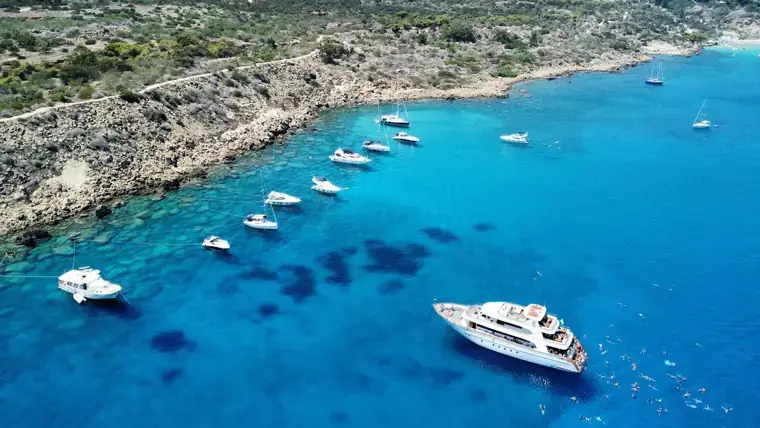
Wider than that, the coast is protected. Cape Gkreko is a national forest park and a Natura 2000 site, and along this shore the fisheries department has established marine protected areas: Kavo Gkreko, the Ayia Napa Sea Caves, and two artificial-reef areas at Ayia Napa and Paralimni. Restrictions on fishing, anchoring and passage apply inside them. The exact list of prohibitions lives in Cypriot secondary legislation; for your route it is named by the operator who leads it.
A rental or a safari: which one to buy
Fifteen minutes off the beach and an hour behind a guide are two different purchases. A rental is a session inside the station’s own area: staff fit a life vest and run the safety briefing before you go, and the operator states no previous experience is needed. Up to four machines go out on one booking, so a group rides together. Nobody leads you anywhere, and nothing stops you turning back after five minutes.
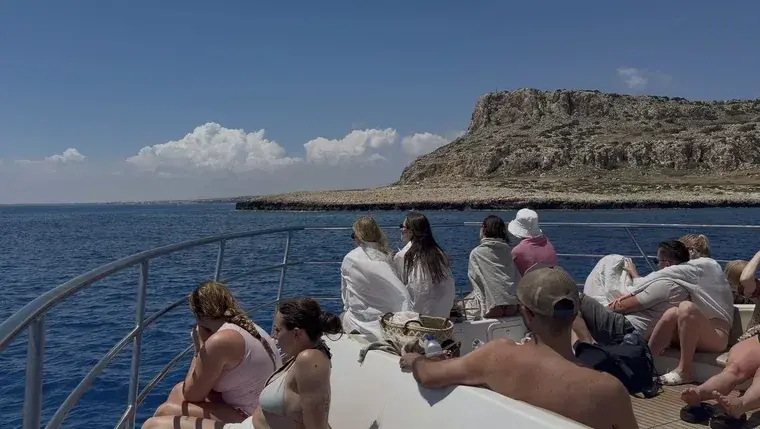
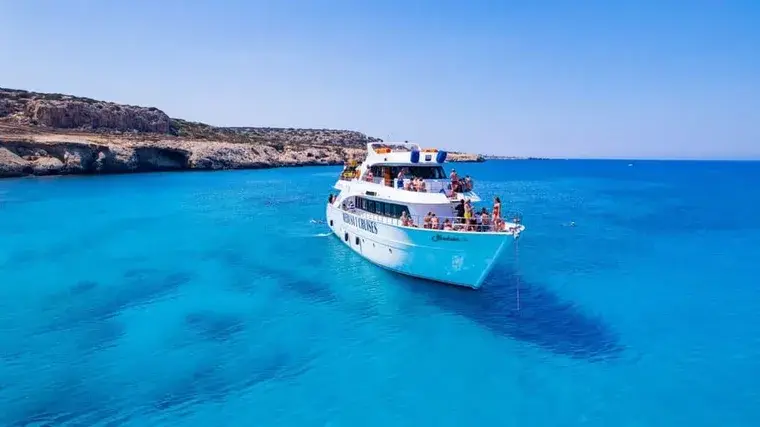
The safari from Kalamies is an hour, swim included. The group leaves the station, runs along the boundary of Famagusta and the Protaras shore, passes Green Bay and Konnos Bay, rounds Cape Greco and stops to swim in the Blue Lagoon before turning back. A professional guide leads the whole way and everyone must follow him — which is exactly why the operator says a licence is not needed. Route and swim stop may be adjusted for sea state and weather.
Which of the two you buy comes down to one question: do you want the coast, or do you want the machine? The rental answers the second and needs no planning — Baywatch says outright that no booking is required and you can simply drop by the beach. The safari answers the first, and that one does need planning: two machines set off together, and the group follows the guide.
Questions people ask at the station
Do you need a licence for a jet ski in Cyprus?
A visitor staying under thirty days may drive a rented machine without one, but only after signing a binding declaration with the owner, who must satisfy himself you have the required knowledge. The licences themselves exist: learner's from 17, operator's from 18.
Is the price for one rider or for the machine?
For the machine. At Baywatch on Kalamies Beach fifteen minutes cost €50, twenty €60 and thirty €90, and a second rider on the same machine is not charged. On the guided safari from the same station a second rider adds €50, so €150 becomes €200.
From what age can you drive one?
The operator decides, not the law. On the guided safari from Kalamies Beach the driver must be 18, and up to two people ride each machine. The plain rental off the same beach publishes no age at all — ask at the station.
How do you tell a legal station from a doubtful one?
By what hangs on the wall. A hire vessel of the public category must display the hire price in English and Greek, plus a board of the owner's and operator's duties, and carries the letter «B» after its number. The station holds a municipal beach licence.