Water activities are sold through four different channels, and what separates them is not the price but who owes you something and whose hands the money passes through. An operator selling on its own site takes the payment and runs the trip itself. A boat marketplace — GetMyBoat, Boatsetter — charges the full amount to your card the moment the booking is confirmed and holds it until the trip is over. An experience marketplace — Viator, GetYourGuide — resells an operator's finished product and pays the operator after the trip, minus its commission. A hotel desk and a beach agent publish neither prices nor conditions. We work a fifth way: your contract is with the operator, the money never passes through us, and what stays on our side is translation, matching and price-checking.
- The four buying channels and what actually separates them
- GetMyBoat and Boatsetter: what their own pages say
- Viator and GetYourGuide: what they publish and what they leave out
- What happens after you press the button here, and where the price comes from
- What to check in any channel before you pay
Important
Everything said here about other platforms is taken from their own public pages and was checked on 22 September 2026. Where a condition is not published, this article says so. Everything said about us was checked against the code and the data of this site, not against a marketing promise.
What are the choices?
There are four channels, and the question of where you come out ahead is answered differently in each, because the money travels a different route.
Booking directly with the operator means paying the person who puts you in the boat. There is no intermediary commission, the cancellation terms are set and honoured by the same company, and the conversation happens in whatever language that company works in. What you can check in advance is its own site and the reviews of its own base.
A boat marketplace works like a home-rental platform: owners post their fleet, and the payment, the holding of the money and a layer of rules on top of the owner's rules belong to the platform. The party answerable to you is the platform, not the owner of the boat.
An experience marketplace works like a shop selling other people's goods: the operator hands over its product, the shop sells it under its own name, takes the money and settles with the operator afterwards. The commission is already inside the price you see.
A hotel desk and a beach agent sell the same trips by voice. There is no price list, no cancellation terms and no reviews of that particular stand to read in advance — the checking has to happen on the spot, in conversation.
How do boat marketplaces work?
GetMyBoat describes the purchase in three steps: you send a booking inquiry, you chat with the owner, you receive an offer and you accept it. At that moment your card is charged the full amount — the platform states plainly that it has no partial payments and no deposit to hold a reservation, and that the money is not passed to the owner until the trip has been completed. The service fee is published: 13% on transactions in dollars and 16% in other currencies, non-refundable except in extenuating circumstances. Only credit cards are accepted, Apple Pay and Google Pay included; prepaid cards are not, and paying outside the platform is forbidden, with tips to the captain as the single exception.
The damage deposit at GetMyBoat is built differently from the usual one. The platform calls it a security allowance, shows the amount in the offer before you confirm, and stresses that it is never charged as part of the booking payment. It can only be charged if the owner files a valid claim within 48 hours after the trip, and you are notified by email when a claim is opened.
Boatsetter publishes a different order. The card is charged the full amount once the trip is approved, payments run through Stripe, and the deposit is taken as a hold: the Boatsetter Promise page says it is held 48 hours before the trip and refunded 48 hours after, provided the boat is undamaged. Its own fee policy page says something else: a minimum of $500 per rental, with owners free to set more, and the hold released 72 hours after the rental period ends if no claim has been filed. Two of the platform's own pages name different windows, which is worth remembering when you plan for the money to come back.
Boatsetter does not publish its service fee to the guest. What it does publish is the owner's share: between 65% and 88.5% of the list price, depending on the boat and the insurance plan. The same page names a $30 administrative fee for disputes and a $15 chargeback fee.
Cancellation terms on Boatsetter are chosen by the boat owner from three standard sets: flexible — free up to 24 hours before; moderate — free up to 5 days, with half the money back between 2 and 5 days; strict — free up to 30 days, with half back between 14 and 30 days. On top of those sits a list of extenuating circumstances: a full refund if the booking falls within 150 miles of a named storm, or under a government weather warning in force within eight hours of the start. Ordinary rain is explicitly not treated as an extenuating circumstance.
One more thing neither platform hides: on 18 December 2025 Boatsetter published an announcement of its merger with GetMyBoat into a single company. When you compare the two, remember they are no longer independent competitors.
| Condition | GetMyBoat | Boatsetter |
|---|---|---|
| When the money is taken | On accepting the owner's offer, in full | Once the trip is approved, in full |
| Service fee paid by the guest | 13% in dollars, 16% in other currencies | Not published |
| What it publishes about the operator's share | Not published | Owner payout of 65–88.5% of the list price |
| Damage deposit | Never charged at booking; only on a claim filed within 48 hours after the trip | A hold, minimum $500; released after 48 or 72 hours, depending on the page |
| Cancellation | The platform's own terms, not set out on its how-it-works page | Three standard sets chosen by the owner, plus a list of extenuating circumstances |
| Payment methods | Credit card only, Apple Pay and Google Pay included; prepaid cards refused | Card through Stripe |
How do experience marketplaces work?
GetYourGuide answers the commission question honestly and without a number. Its own site for operators says that posting an activity is free, that a commission is charged only on bookings that actually happen, and that the rate "may vary depending on your country of operation — the exact amount will be shared after you sign up". From the guest's side, in other words, the platform's share of the price cannot be known in advance. The same page says operators are paid monthly at no extra cost or twice a month with a surcharge, and that each pay run covers all fulfilled bookings minus the commission — the guest's money travels through the platform, not through the operator. The platform states its own scale: over 200,000 activities in more than 120,000 cities, 37 languages and currencies, and connections to more than a hundred operator reservation systems.
Viator does not publish its commission from operators either. What it does publish is the commission going the other way, to the creators who bring buyers: 8% on every completed booking, a 30-day cookie, and a sign-up through a Tripadvisor account. The same pages carry its scale: over 300,000 experiences across 2,500 destinations and more than a million reviews.
For a guest this means one thing: at an experience marketplace you are buying from a shop, not from the operator. The price on the shelf already contains a commission whose size is not named, and a refund after a cancellation travels back through the shop under the shop's rules, not under the rules of whoever takes the boat out.
What can you check at a hotel desk or with a beach agent?
Almost nothing, and that is the defining difference of the channel. Neither the desk in the lobby nor the man with the laminated folder on the sand has a public page saying what the trip costs, what the price includes, which operator runs it, how the money comes back when the weather closes the port, and what happens if something breaks. All of it exists, but it exists as speech.
One thing here is checkable: the operator's name. Once it is said, the ordinary checks work again — the operator's site, its price, its reviews, its cancellation terms. If the name is not given, there is nothing to compare, and a receipt handed over on the beach rarely carries a company name.
What happens after you press the button here?
The button on an activity page opens WhatsApp with the message already written. It carries the name of the activity, the number of guests and the date you picked next to the button, and an approximate total. Pressing it starts nothing else: there is no payment form on this site at all, there is not a single payment provider in the site's code, and no card field will be shown to you anywhere. Three forms live on the site — search, an email to us, and the chat window.
There is one number for every destination: +34 665 061 186 — a single line in the site settings, the same for every country. The conversation runs in the language of the page you opened: the site and the chat work in English, Russian, German and Spanish. The chat answers on the page itself and hands the conversation to a person when the question goes beyond what has been published.
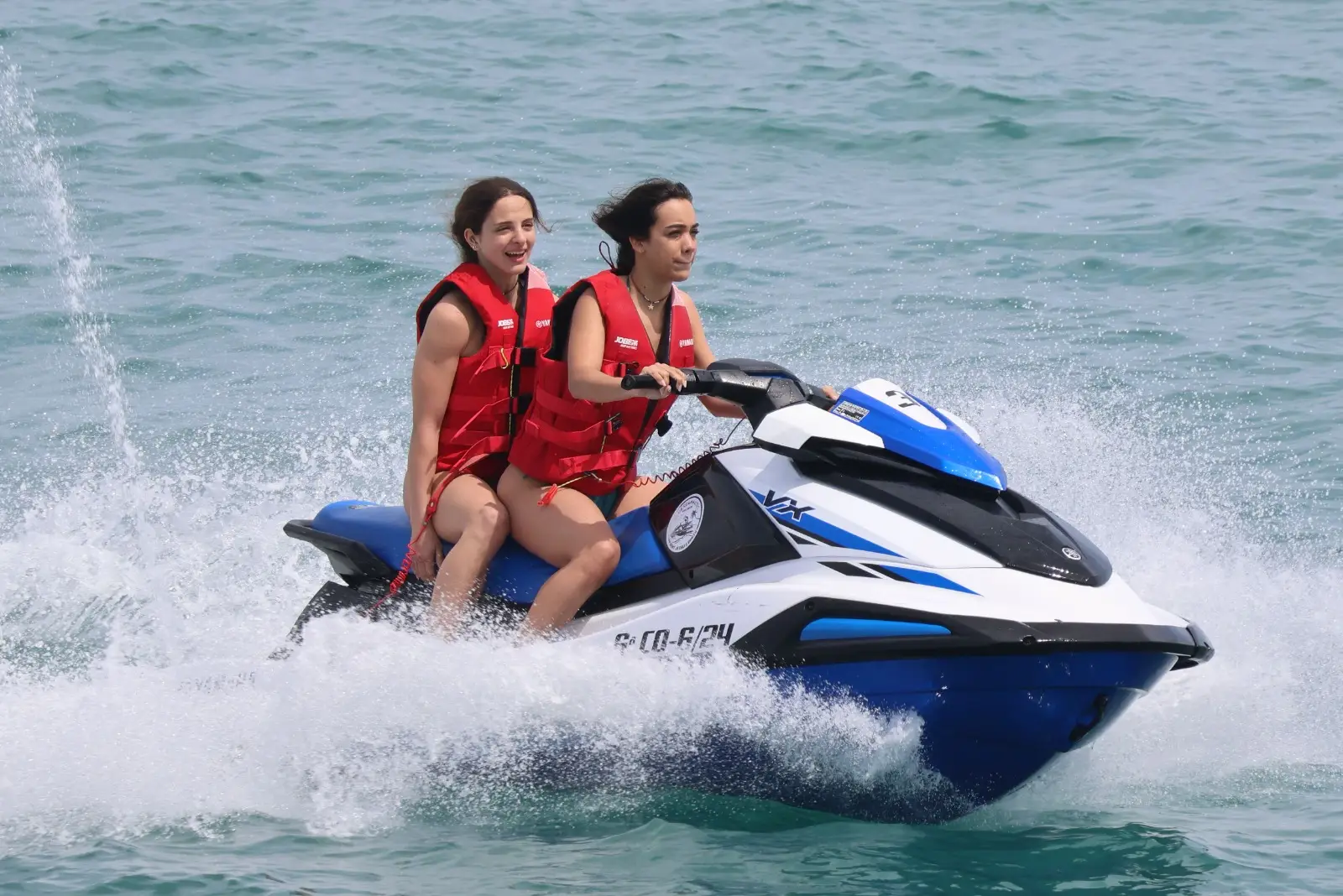
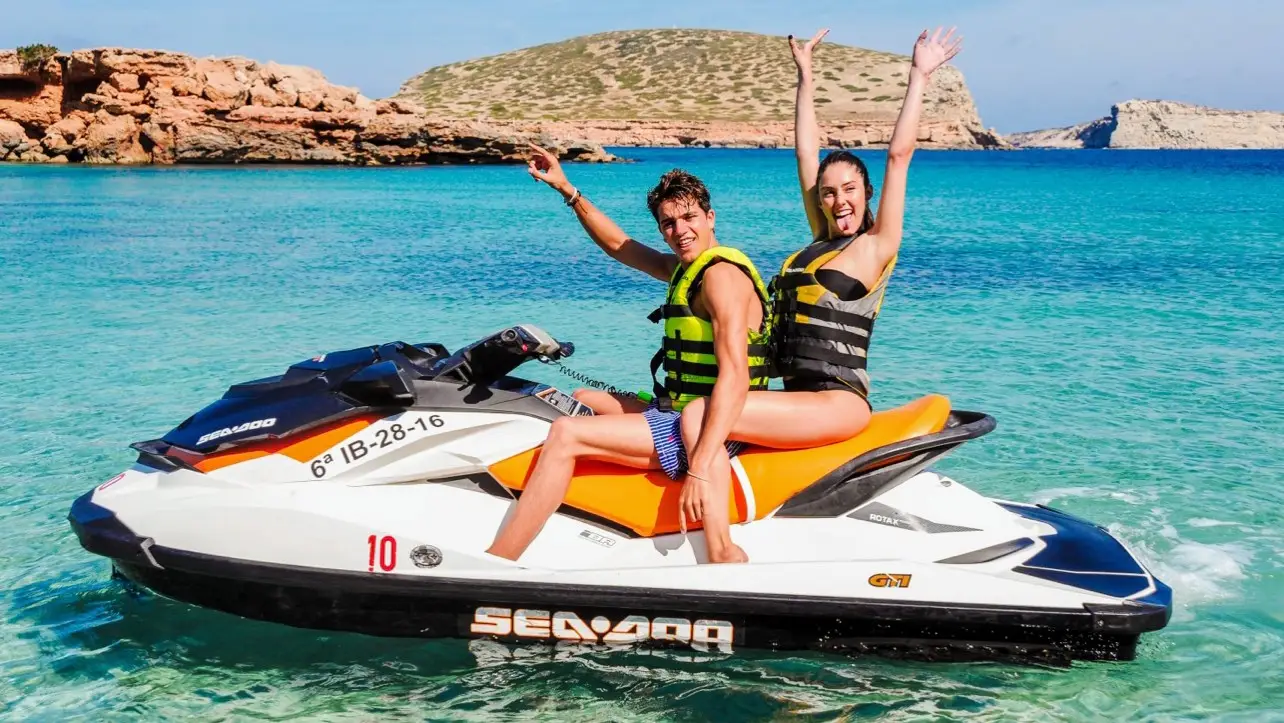
Take the jet-ski safari to Es Vedrà on Ibiza as an example: €200 per jet ski rather than per person — two riders share the machine. The unit stands next to the amount, and it is the unit that goes into the message along with the number of guests.

From there the money does not travel through us. The site's terms put it plainly: the contract for an activity is made between you and the operator, we act as an intermediary, payment is made to the operator — on site or online, by the methods that operator accepts — and refunds are made by the operator under its own policy. The list of payment methods on an activity page (Visa, Mastercard, Apple Pay, Google Pay, PayPal, cash) is what the operator accepts, not a till on this site.
An online prepayment is the exception here rather than the rule. Of 438 published activities, exactly one asks for it: the guided jet-ski tour along Valencia's north coast, where €35 per person is paid online to hold the place and the remaining €140 goes to the operator on the day, by card or in cash. Every other activity carries the standard cancellation line: free up to 24 hours before, unless the page itself says otherwise.
Where does the price come from, and when was it last checked?
The price you see is the operator's price, not our mark-up on top. In the site's data every activity can carry a price-source field: the kind of source, a link to the operator's page the figure was taken from, and the date it was checked. Of 438 published activities, 232 carry that field, and 228 of those point to the operator's own page; the most common check date is 11 September 2026 and the most recent is 18 September. The remaining activities have no such field, and that is visible in the data itself.
The check date lives in the data and is not printed on the page — an internal check reads it, not a reader. So the rule is the same for us and for you: the price here is an entry point, and the operator confirms the final amount before a booking becomes a booking. That is what the site's terms say as well.
The other half of an honest price is the unit. Across 438 activities it breaks down like this: 247 are charged per person, 90 for the whole boat, 59 per session, 38 per jet ski and 4 per hour. The currency is the operator's too: 241 activities are in euros, 100 in baht, 46 in dollars, and the rest in dong, dirhams, pesos and pounds. The currency switcher at the top of the page changes only what is comfortable for you to read; you will pay in the operator's currency.
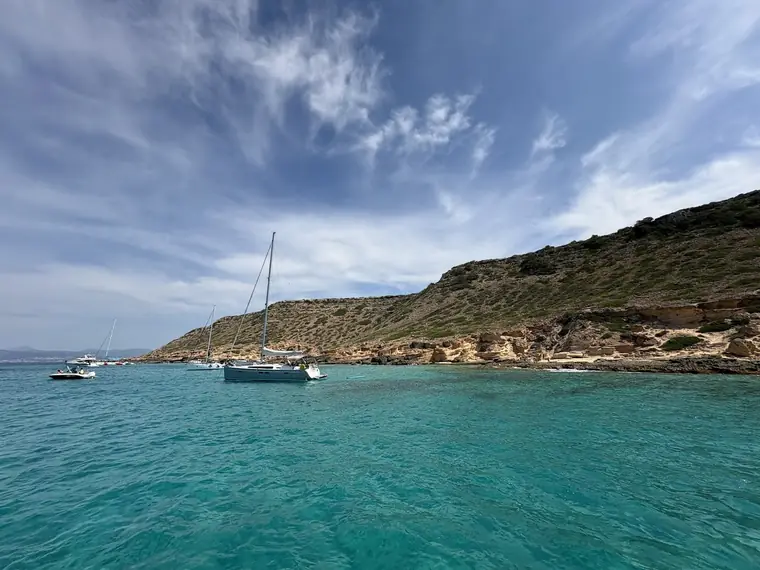
The day cruise on a catamaran from northern Mallorca, for instance, carries €59 per person in the data, a link to the operator page the figure came from, and a check date.
The channels side by side
The table hands out no marks: each channel has its own mechanics, and the one to pick depends on the task rather than the label.
| Where to look | Visible in advance | Who answers for a cancellation | Language of support |
|---|---|---|---|
| The operator's own site | Its price, its programme, its terms, exactly as it published them | The operator, under its own rules | Whichever it works in |
| GetMyBoat | The owner's listing, reviews, the deposit amount in the offer before you confirm; a service fee of 13% or 16% | The platform: it holds the money until the trip ends | The platform publishes its own pages in six languages: English, Spanish, French, Japanese, Portuguese and Catalan |
| Boatsetter | The owner's listing, the cancellation set the owner chose, a hold of at least $500 | The platform: standard terms plus a list of extenuating circumstances | Not stated on the pages read |
| Viator, GetYourGuide | A shelf price that already contains a commission of unnamed size | The platform, under its own rules | GetYourGuide names 37 languages and currencies; Viator does not state it on the pages read |
| Hotel desk, beach agent | Nothing: no price list, no terms, no operator name until you ask | Not published | Not published |
| elyxta.store | The operator's price with its unit; for 232 of 438 activities, a link to its page and a check date in the site's data | The operator, under its own policy; the contract is with it | English, Russian, German, Spanish — page, chat and WhatsApp |
What to look at before you book
Six questions work in any channel, and the answer to each is either published or it is not — there is no third state.
The unit of the price. An amount without a unit means nothing: €200 per jet ski for two riders and €200 per person differ by a factor of two. How the same category is counted differently by neighbouring operators is worked through in Jet skis and watersports in Valencia: how to read the price.
What is included. Park fees, fuel, transfers, equipment and tax sit sometimes inside the price and sometimes as a separate line paid on the day. Which items most often stay off the page is shown in What changes your bill in Dubai: the online rate, VAT and minimums.
The deposit and liability for damage. What differs here is not the amounts but the mechanics: a hold on the card, cash against a signature, or a charge only after a claim. How jet-ski rentals handle it, and what to do about a claim, is worked through in Jet ski rental in Phuket: prices, deposit and scratch claims.
The minimum age. Most activities set their own, and the passenger age is almost always lower than the driver's. Ages and formats for a family are covered separately in Valencia with children: from what age, and which trip fits.
Licences. In Spain this stops being theory: RD 1188/2025 rewrites article 10 of RD 875/2014, and from 1 October 2026 the licence-free exception covers private and sporting use only — so the person hiring a motorboat of up to 5 metres and up to 15 CV must hold a qualification. Jet skis are taken out of that rule, and it does not touch skippered boats. The detail, and what it means for a booking already paid for, is in Spain, 1 October 2026: the person hiring a boat needs a licence. For a contrast, the same question in Cyprus is in Jet ski in Cyprus: the licence, the declaration and the price per machine.
Cancellation and weather. A cancellation by you and a cancellation because the port is shut are two different events with different money, and every company words them its own way. What counts as bad weather in practice, and how it looks on the day, is shown in Ibiza on the water: wind, wetsuit and what happens when the weather turns.