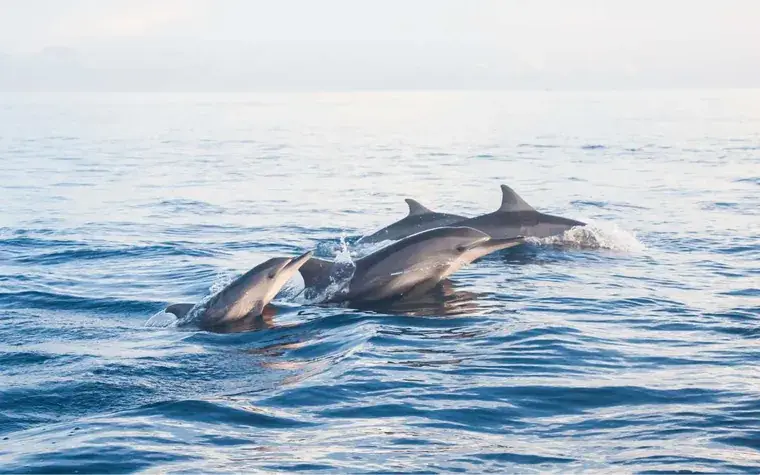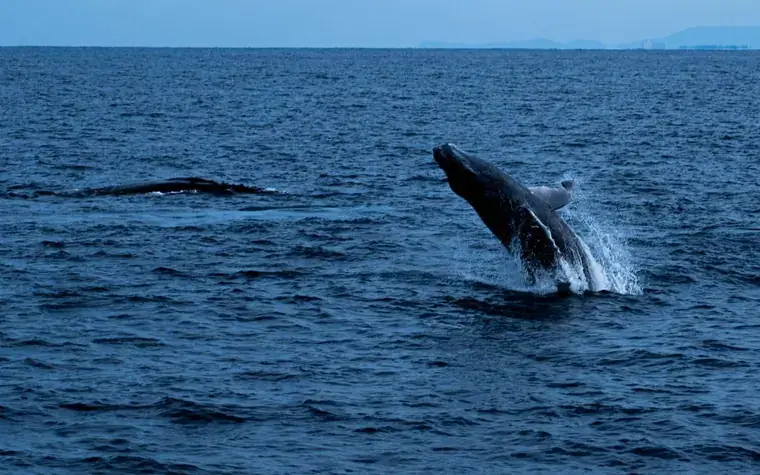
The question is asked at the ticket desk in four languages, and it is always the same question: will we definitely see dolphins? The honest answer is that nobody at the harbour of Morro Jable can promise an animal. What they can promise is a boat, a route, a time and a crew that knows where to look.
That is not a way of dodging the question. It is what Spanish law makes of a cetacean trip: the rules that govern how a boat may behave near dolphins and whales are written to protect the animals from the boat, not to deliver the animals to the boat. Read them once and the whole business stops looking evasive and starts looking simple.
- What the operators out of Morro Jable actually put in writing
- The distances, the speed and the angle of approach the law fixes
- Why two boats at a time is the limit, and what that means for your view
- How to check that the boat you booked is allowed to run this trip
- What changes between a two-hour search and a four-hour sail
- What the same rules require of you if you take the wheel yourself
What follows is the trip described the way it is sold and the way it is regulated, so that the two match before you pay.
What does the operator actually promise?
Magic & Sailing, which runs cetacean trips out of Morro Jable, is unusually direct about it. On the two-hour boat it states that sightings depend on nature and are never guaranteed, and that the crew observes from a distance rather than chasing. On the twelve-guest catamaran the wording is that dolphins turn up often and whales occasionally, always in open water and never guaranteed. On the top boat of the range it says the search may end without a sighting at all.
What is fixed is everything else: the hour of departure, the length of the trip, the harbour, the boat, the food and drinks, the transfer from a meeting point in the south. That is the product you are buying, and it is worth checking the booking conditions in writing — what happens if nothing shows up is a term of contract, not a law of nature, and it differs from operator to operator.
Why the rules turn a boat trip into a search
The norm is Real Decreto 1727/2007, published in the Boletín Oficial del Estado as BOE-A-2008-516 in issue no. 11 of 12 January 2008 and in force from 13 January 2008. It draws an imaginary cylinder around every animal or group — the Espacio Móvil de Protección de Cetáceos — with a radius of 500 m, 500 m of air above it and 60 m of water below. A group, in the text, means two or more animals no more than 50 m apart.
- Exclusion zone — at least 60 m around the animal: no vessel may be there at all
- Restricted zone — from 60 m to 300 m: two vessels at a time, and none at all if there is a lone calf or an adult with a calf
- Approach zone — from 300 m to 500 m: again two vessels, waiting their turn on the radio
- Aerial zone — the air within 500 m: closed
- Underwater zone — down to 60 m below: closed
Inside that space a commercial boat holds a steady speed of no more than 4 knots and never faster than the slowest animal in the group. It approaches gently, on a converging course at an angle of about 30° to the way the animals are heading — never head-on, never from behind, never at right angles — then runs parallel without sudden changes of course or speed. Circling is banned. So is going astern, except to avoid a collision.
If the engine is stopped and restarted, the boat stays in neutral for at least a minute, and when several boats work the same group they coordinate the manoeuvre by radio.
- No physical contact between the boat, or anyone on it, and an animal
- No feeding, and nothing thrown into the water — food, drink or rubbish
- No crossing the animals' path, cutting them off or passing through a group
- No splitting or scattering a group, and never coming between an adult and a calf
- No loud or sudden noise, above or below the water, to attract or drive the animals
- No sonar or acoustic gear used to find them or push them to the surface, and no swimming or diving in the exclusion zone
Two vessels at a time in each of the two outer rings is the rule that decides what your afternoon looks like. If a group has already drawn a crowd, the boat waits its turn on the radio instead of joining the crowd, and you watch from farther away or move on to look for another group. A crew that behaved otherwise would be breaking a royal decree enforced by the maritime service of the Guardia Civil, with penalties set under the general nature-protection law. That is the reason a trustworthy skipper will not promise you a close view.
How do you check the boat is allowed to do this?
In the Canary Islands, watching cetaceans commercially is a separately licensed activity under Decreto 178/2000 of the regional government, which keeps a public list of authorised vessels. In the published edition of that list dated September 2022, sixteen entries are attributed to Fuerteventura — seven registered in La Oliva, three in Pájara, one in Puerto del Rosario, one in Tuineje and four with no municipality filled in. Each line is a vessel with a permit rather than a company: one firm may hold several, and the same boat name appears twice.
Two things follow for a passenger. The permit code of a Fuerteventura vessel looks like CT-35-2-…, and it is a fair question to ask before booking: which boat am I sailing on, and what is its code? And authorised boats are required to fly a distinctive Barco Azul flag, issued with the permit and at each annual renewal, so there is something to look for at the quay as well.
Which departure from Morro Jable, and what does the price change?
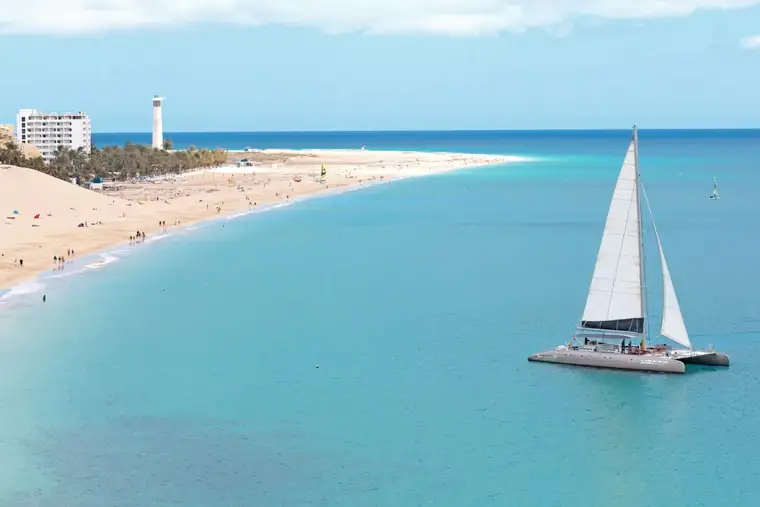
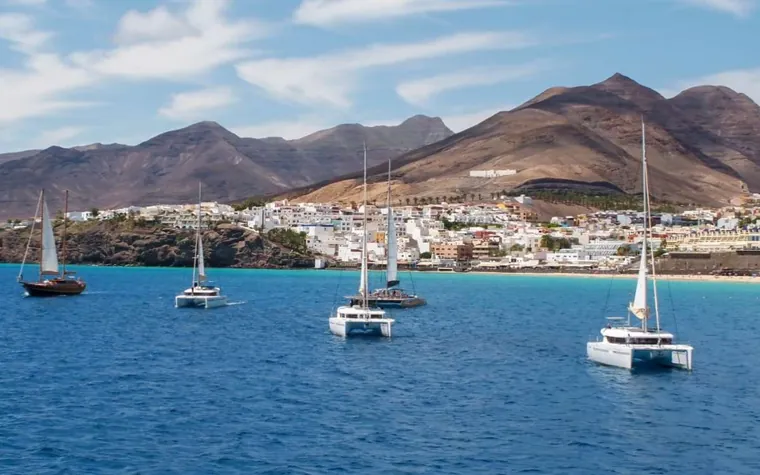
Morro Jable is the working harbour of the south: 290 berths, five metres of draught, vessels up to 35 m, a fuel station, a travelift and round-the-clock security, with the ferry to Gran Canaria on the same quay. The Magic & Sailing boats that work out of it search the same water off the Jandía peninsula and differ in almost everything else.
| Trip | Length | Adult | Child | On board |
|---|---|---|---|---|
| Magic Dolphin | 2 h | €49 | €39 (2–11) | drinks, no food; not under 2 |
| Magic Select | 4 h | €79 | €40 (2–11) | lunch cooked on board, open bar |
| Magic Deluxe | 4 h | €99 | €60 (2–11) | twelve guests, two-course lunch |
| Magic Dreams | 4 h | €125 | — | from 12 years, chef's tapas |
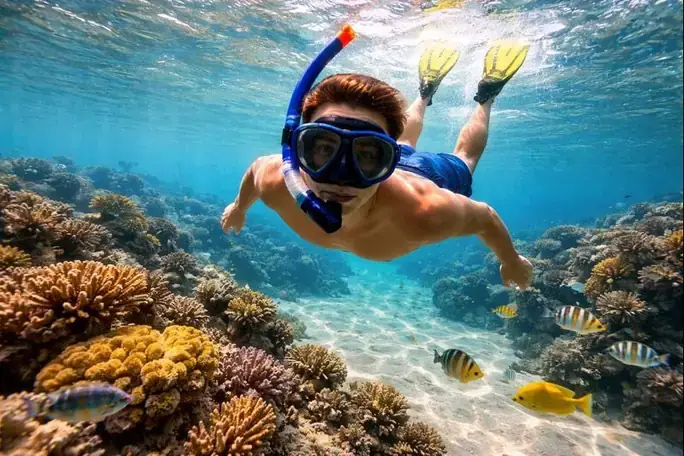
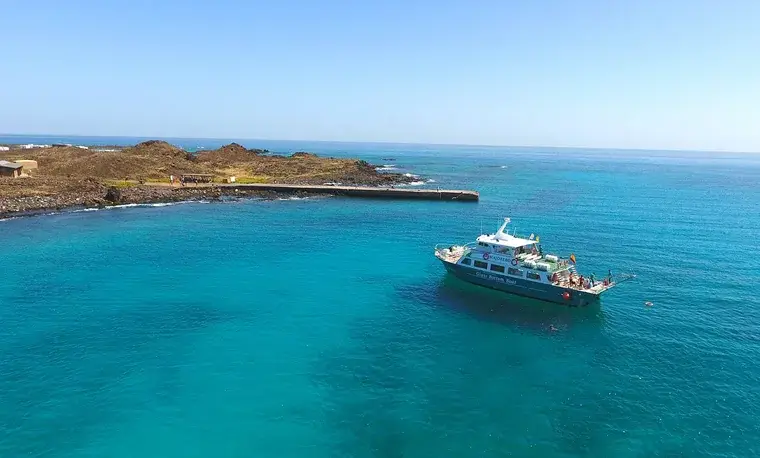
The short one is built around the search and nothing else. Magic Dolphin is an 11.72-metre boat, 4.48 m in the beam, fast enough to cover ground in two hours; €49 for an adult, €39 for a child of two to eleven, an open bar of cold drinks and no food at all, with a swim stop at the end if the sea allows. Babies under two cannot come aboard. Pick-up runs from meeting points in Costa Calma, Esquinzo, Morro Jable and Jandía.
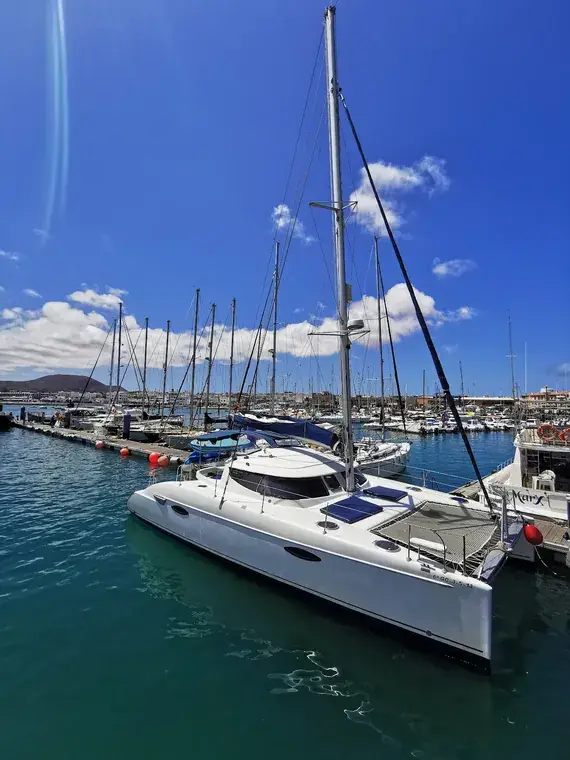
The Magic Select catamaran turns the same water into half a day: 22.80 m long, 10.50 in the beam, a 150 m² sail, four hours, €79 for an adult and €40 for a child of two to eleven, babies free. The search comes first, then an anchorage off the Jandía beaches while lunch is cooked on board — Mozarabic chicken with rice, or a vegetarian burger with Zahara-style rice; allergies need flagging 48 hours ahead.
Same harbour, same four hours, twelve people: Magic Deluxe is a Lagoon 450S of 13.96 by 7.87 m at €99 for an adult and €60 for a child of two to eleven, with hotel transport in the fare and a two-course lunch by a Jandía chef. The cap of twelve, with hotel transport in the fare, is what the extra €20 over the big catamaran buys.
The last one changes the departure point as well. Magic Dreams sails from Jandía Marina rather than the commercial quay, on a Lagoon 43, four hours at €125 per person, guests from twelve years only. Snorkelling gear and paddleboards are on board for the anchorage, and the food is a tapas sequence by a chef of the Salvaje restaurant.
What if you want the boat to yourselves?
You can have it. A private trip with a skipper out of the same harbour is €300 for the boat for three hours for one to four people, €50 for each extra person, with fuel, drinks, snacks and the hotel transfer inside the price; the operator says the client decides the plan at every moment, including taking the helm. Until 30 September 2026 the same operator also let a small Voraz 3.85 with a 15 hp Mercury go out with no qualification at all, from €200 for three hours; from 1 October 2026 a bareboat hire needs a licence from the renter, and the operator asks for «como mínimo el PNB».
The decree does not care whose boat it is. The exclusion zone of 60 m, the ban on crossing a group's path, on circling and on sudden noise apply to your hired boat exactly as they apply to a licensed one. If dolphins come to you of their own accord, the text is explicit: hold your course and your speed rather than manoeuvring around them, keep the propeller out of gear while they are closer than 60 m, and switch the echo sounder off.
Questions that come up before booking
Are dolphins guaranteed?
No, and Magic & Sailing says as much in its own conditions. The animals are wild and the law forbids chasing them. What the fare guarantees is the boat, the hours, the route and what is served on board.
What happens if we see nothing?
That is a matter of the booking conditions rather than of the sea, so settle it in writing before you pay: ask the operator whether a trip without a sighting is repeated, credited or simply finished. The answer differs from boat to boat.
Which month is best for it?
The short search out of Morro Jable runs all year. What the calendar changes is the sea rather than the animals: the trade wind blows every month and hardest in the second half of the day, so a morning departure is usually the calmer one.
How close does the boat get?
No closer than 60 m under its own power — that is the exclusion zone. Between 60 and 300 m only two boats may be present at once, and none at all where there is a calf. Anything closer than that happens because the animals chose it.
Can we bring children?
On the two-hour search, from two years, at €39; babies under two are not accepted. The two big catamarans take children from two at €40 and €60, babies free. Magic Dreams is from twelve years upwards.
Rules of approach: Real Decreto 1727/2007 (BOE-A-2008-516, consolidated text), read on 7 September 2026. Licensing and the list of authorised vessels: Gobierno de Canarias, Decreto 178/2000 and the published list dated September 2022. Harbour data: fuerteventuraturismo.es. Prices, durations and conditions: the operators' own pages, read on 7 September 2026.