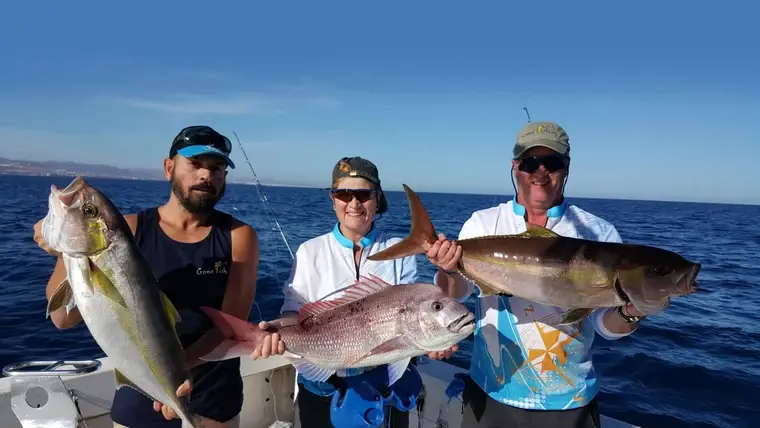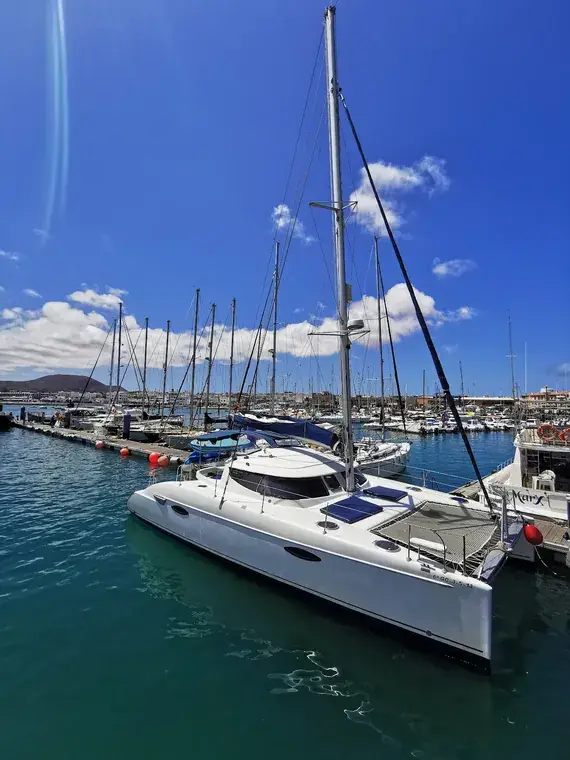
The question usually arrives as a hotel question and gets answered with photographs. On the water it is a different question. The half of the island you sleep on decides what you can actually buy, because almost everything here leaves from one particular harbour and comes back to the same one.
- What goes out from Corralejo — and the one thing that goes out from nowhere else
- What goes out from Morro Jable and the Jandia shore
- Why Caleta de Fuste is a working base and not merely the airport's neighbour
- How far each base is from the airport, and which of those numbers are measured
- Why an operator's pick-up radius matters more than the kilometres on the map
- Which half fits which trip, and what each one costs you
What follows is the measurable part: the harbour, the departure point, the price, the drive. Which coast is prettier belongs to the forums.
Important
Hiring a boat without a licence has an end date. Until 30 September 2026 a boat under 5 metres with a motor of up to 15 CV may be hired without a licence, no further than 2 nautical miles from the port, in daylight only and from the age of 18. From 1 October 2026 RD 1188/2025 requires the person hiring the boat to hold the relevant qualification. Jet skis and skippered departures are not affected.
Where each kind of day starts
Fuerteventura runs north-east to south-west, and its sea traffic gathers at a handful of points. The island's official portal keeps a section for harbours and marinas with five entries in it: Corralejo, Puerto del Rosario, El Castillo at Caleta de Fuste, Gran Tarajal and Morro Jable. Read that as the portal's own list rather than a census of the island's moorings — El Cotillo, a fishing village on the north-west coast, does not appear in it at all.
| Base | What goes out on the water | An example price |
|---|---|---|
| Corralejo (north) | Isla de Lobos under sail, by catamaran, by sea kayak and by jet ski; guided dives and first dives at Lobos; shared and private fishing, including an eight-hour trolling day | €35 for a sunset sail |
| Morro Jable and Jandia (south) | A search for dolphins and whales; catamarans along the Jandia coast; boat dives and boat snorkelling on the Jandia drop-off; a seat or the whole boat for fishing; a jet ski safari; a boat you skipper yourself without a licence | €40 for boat snorkelling |
| Costa Calma, Sotavento and Matas Blancas (south) | Kite, windsurf and wing-foil schools on the shore; walk-in dives with a free hotel transfer; a kayak-and-snorkel morning at La Lajita | €45 for a dive or a kayak morning |
| Caleta de Fuste (east) | A jet ski circuit inside the bay; kayaks and paddleboards by the hour straight off the marina; a morning of bottom fishing | €15 for an hour in a kayak |
One line in that table has no twin. Isla de Lobos is reached by sea and only from the harbour of Corralejo — that is the island portal's own wording, and it is the single hard geographical fact in this whole comparison. Everything else exists in some form on both sides; what changes is the format, the price and the length of the drive.
North: Corralejo, and what only stands next to it
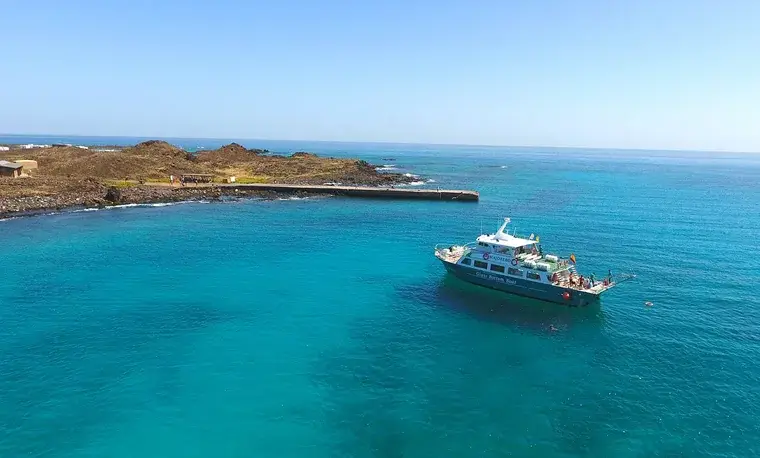
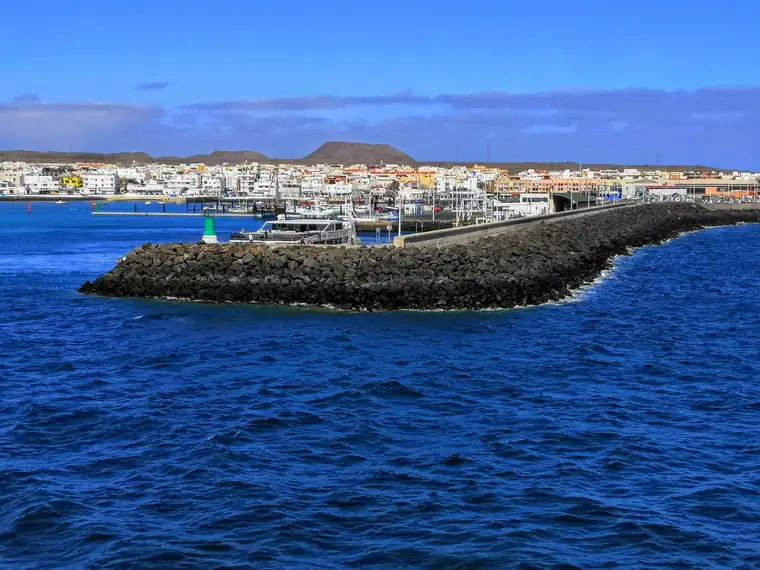
The marina sits five minutes' walk from the town: 215 berths for vessels up to 15 m, showers and toilets, a space kept for the ferries that link it to other ports, and a rock formation off the harbour entrance that the portal warns is easy to miss. The number that matters for a holiday, though, is a different one: the anchorage at Isla de Lobos is less than fifteen minutes away.
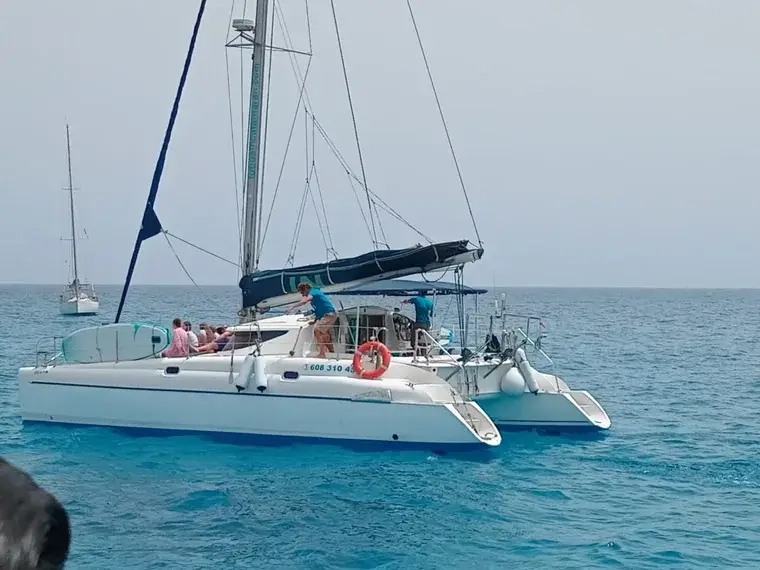
That short hop is what the north sells. A shared catamaran to Lobos takes ten guests at most for four hours at €65 an adult and €45 a child aged 3 to 11, with lunch cooked that morning, masks, wetsuits and four paddleboards on board. The paella catamaran runs the same four hours at €69 an adult and €41 a child aged 3 to 12, with kayaks and boards along and the free Cabildo permit added to the ticket on request.
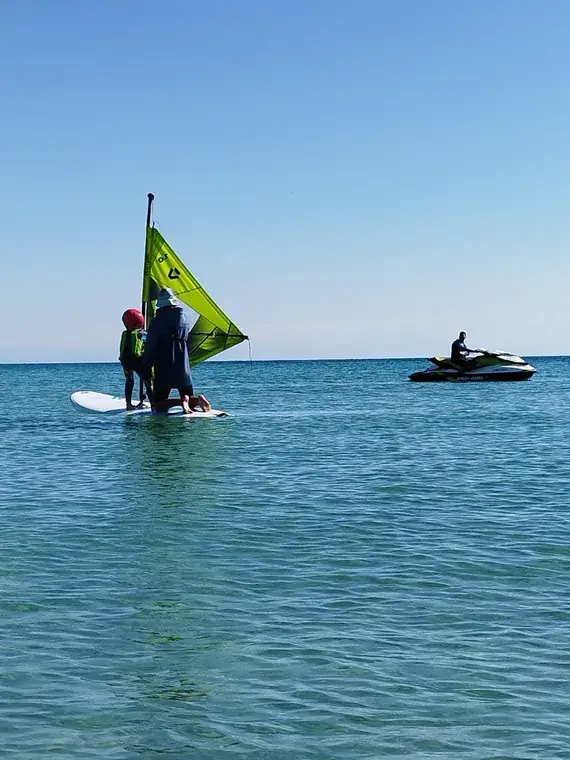
Under sail it is cheaper: a four-hour shared sail around the islet is €50 and the two-and-a-half-hour sunset sail is €35, neither with food. If you would rather have the boat to yourself, a 13.6 m Bavaria 44 with its skipper is €200 for two hours and €370 for four — for the boat, not the seat, up to nine guests — and a four-metre sailing dinghy goes out at €45 an hour with no licence, the skipper who teaches you costing the same €45.
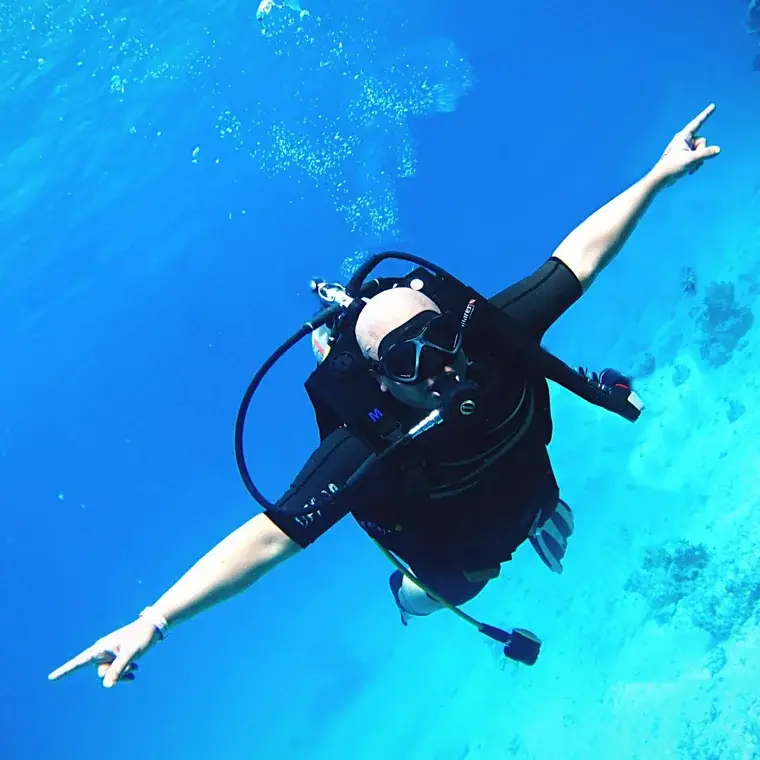
Underwater and on engines the pattern repeats. Guided dives at Lobos start from €50 with two daily departures, 08:30 for experienced divers and 10:30 for all certified levels; the surface-supplied option takes families from ten years old from €89, the air coming down a hose instead of a tank on your back. A first dive with a PADI instructor is €100 for the morning, and the same centre's shore dives for certified divers are €55 for one and €180 for four — run, notably, on the east coast rather than the north.
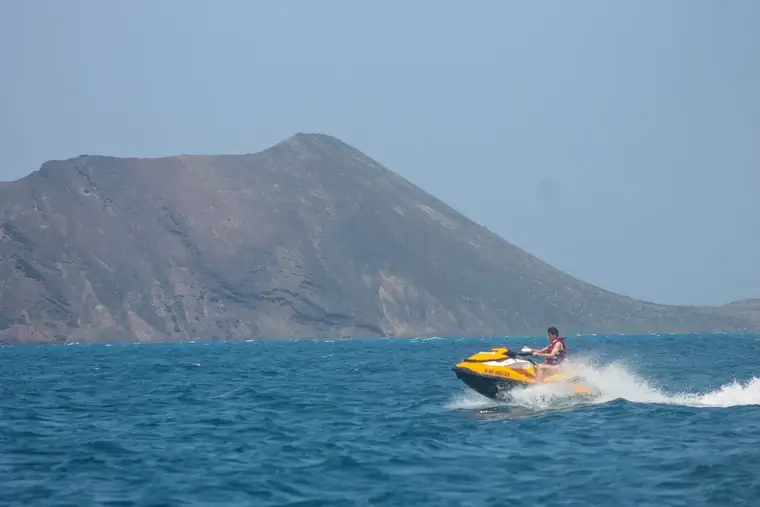
A ninety-minute jet ski loop around Lobos is €145 per machine with one rider and €160 with two, while the forty-minute run along the dunes is €85 per machine with one and €100 with two; the operator's standard prices are €169 and €189 for the loop and €99 and €119 for the safari. The kayak crossing to Lobos — nine kilometres of paddling, 9:00 to 15:00, €60 a person — includes the guided walk with an environmental technician and the authorisation, which the operator obtains for you.
Fishing splits the same way: a seat on a five-hour bottom-fishing trip is €95 with six places at the 08:00 departure, and an eight-hour trolling day for the whole boat is €800 — the two prices the operator shows against €105 and €890.
One rule governs the whole northern list. Setting foot in the Parque Natural Islote de Lobos requires an authorisation from the Cabildo, obtained in advance and free of charge through the LobosPass web app; the management plan caps the park at 200 simultaneous visitors and the Cabildo runs two shifts, 10:00 to 14:00 and 14:00 to 18:00, with the calendar opening days ahead rather than months. Boat trips that anchor off the islet without landing are a different case — the jet ski loop, for one, circles it and stops in the water. How the permit is obtained, and what it does and does not cover, is a subject of its own and has its own article.
Harbour figures and the rule that Lobos is reached only by sea from Corralejo: the island's official tourism portal, read 7 September 2026. Permit, limit and shifts: Cabildo de Fuerteventura and the LobosPass web app, read 7 September 2026. Prices and what they include: the operators' own pages, read 7 September 2026.
South: Morro Jable, Jandia and Costa Calma
Morro Jable is the largest of the five harbours the portal lists, by berths and by the size of vessel it takes: 290 berths, a five-metre draught, boats up to 35 m, a fuel station, a travelift, round-the-clock security and the regular passenger ferry to Gran Canaria, which is the closest island from here. Next to it stands the fishermen's guild. It is a working port, and the difference shows in what departs from it.
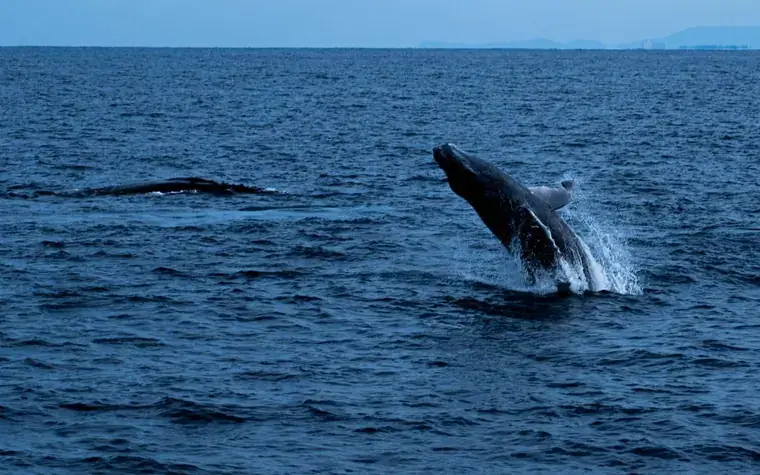
The southern boat day is built around the open Atlantic rather than an islet. A two-hour search for dolphins, pilot whales and beaked whales on an 11.72 m boat is €49 an adult and €39 a child aged 2 to 11; a 23-metre catamaran works the same coast for four hours at €79 with lunch cooked on board; a twelve-guest Lagoon 450S does it at €99 with a two-course lunch and hotel transport included, and the Lagoon 43 at €125. In the evening a 19.70 m Turkish gulet sails for the sunset behind the lighthouse at €89, adults only.
And if you want the whole boat rather than a seat on one, three hours out of Morro Jable with a skipper from the operator is €300 for the boat for one to four people, with fuel, drinks, snacks and the hotel transfer inside the price.
Diving here happens from a boat as a matter of course. Boat dives on the Jandia drop-off leave the port at 09:00 and 11:00 at €45 per person per dive, dropping to €40 from the fifth; a two-hour boat snorkelling trip, an hour of it guided in the water, is €40 and a first dive from that same boat is €105 per person with 7 % IGIC on top. Further up the coast, walk-in dives out of Costa Calma are €45 plus €5 insurance and €10 for gear, with the hotel transfer free.
Fishing is sold both ways from the same quay: a seat on the five-hour trip to Punta de Jandia is €100 with no more than four aboard, and the same five hours as a private charter is €400 for the boat. On engines and paddles, a jet ski safari on the Jandia side is €80 for half an hour per machine whether one or two ride it and €149 for the hour, and a two-hour kayak and snorkel at La Lajita is €45, or €40.50 booked online.
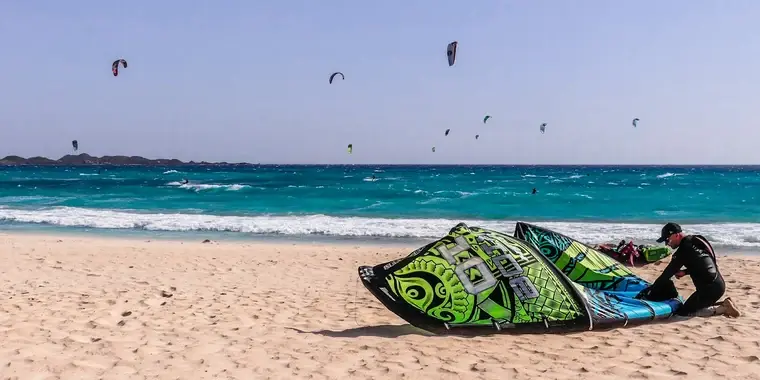
The south is also where the wind schools are, on the Sotavento lagoon and at Matas Blancas near Costa Calma. That comparison — flat tidal water against the open dune beach of the north — is a whole subject in itself and has its own article; for the purposes of choosing a base, only one thing about it matters here.
The schools stand on the beach, not in the harbour, and the portal measures Costa Calma and Morro Jable only from the airport: 65 km and an hour to the first, 84 km and an hour and a quarter to the second. It publishes no measurement between them.
East: Caleta de Fuste, the base people forget
Puerto Castillo is under ten minutes from Puerto del Rosario and from the airport: 110 berths, a draught of up to five metres, vessels to 16 m, showers, a crane, a travelift and round-the-clock security, with the portal noting that everything from jet ski hire to diving lessons is sold beside the marina.
In practice that means the water starts where you park. Twenty minutes on a marked circuit in the bay is €68 per jet ski whether one or two people ride it; a kayak or paddleboard by the hour is €15 for a single, €25 for a double and €15 for a SUP; a morning of bottom fishing on a twelve-place sportfisherman runs 09:00 to 13:00 at €79 for an angler and €60 for a companion who only watches.
The east coast is also where those Corralejo shore dives actually take place, at El Jablito, Archies Bay and Las Salinas. So a base here is not a compromise between the two halves — it is a short drive from the plane and water at the end of the street. What it does not have is the rest of this article: no Lobos, no Jandia dolphin search, no lagoon.
How far it really is, and which numbers are measured
The island's official portal publishes its distances from one place only, the airport: 39 km and 40 minutes to Corralejo, 84 km and an hour and a quarter to Morro Jable, 65 km and an hour to Costa Calma, 8 km and ten minutes to Caleta de Fuste. Taxi fares on the same page are given as approximate — 40 to €50 to the north, 85 to €95 to the south, with no figure for Caleta de Fuste.
The airport lies between the two ends, so crossing from one to the other is those two drives run back to back; the portal publishes no measurement for that leg, and this is not a number to invent.
Public transport follows the same geometry. Three Tiadhe bus lines leave the terminal: line 3 to Caleta de Fuste, line 10 to Morro Jable, line 16 to Gran Tarajal. There is no direct airport line to Corralejo in the airport's own list, and the airport publishes no timetables. The portal calls a hire car the best way to see the island, adds that a four-wheel drive is advisable for Cofete and some of the wild beaches — the track is 8.5 km — and reserves the bus for people who are not moving constantly or who live by a stop.
One more thing worth knowing before you book a room in the capital: Puerto del Rosario is described as mainly commercial and transport, a port of ferries and cruise ships rather than a place where day trips begin.
Distances, taxi estimates, bus advice and the note on Cofete: the island's official tourism portal, read 7 September 2026, where the fares are the portal's own approximations. Airport bus lines: Aena, read 7 September 2026 — the same page publishes no timetables and no direct line to Corralejo.
The pick-up radius decides more than the kilometres
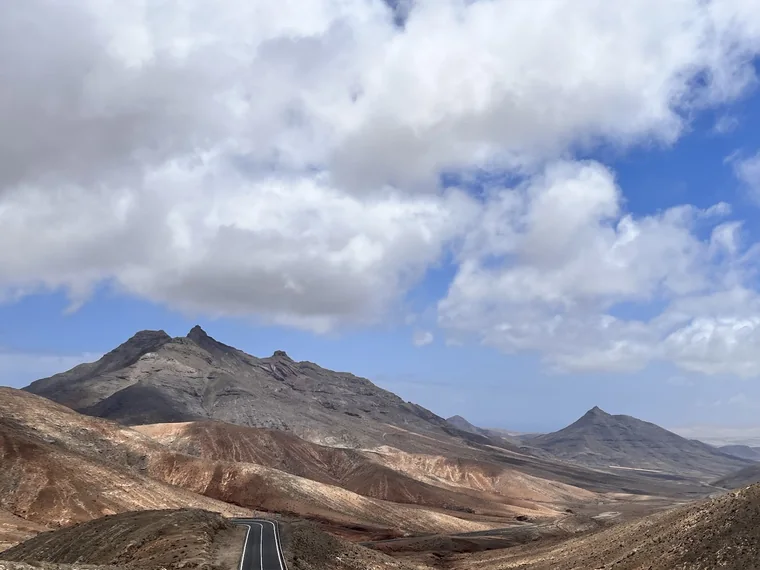
Operators draw their own map of the island, and it is narrower than the road map. The Corralejo catamaran picks up on request within the Corralejo area only, up to seven passengers, and names the places it does not serve: Cotillo, Origomare, Lajares, Puerto del Rosario and Caleta de Fuste. The kayak days collect you inside Corralejo at 9:00 and drop you back there. In other words, the northern product is written for somebody already sleeping in Corralejo.
The south draws its line along the resort strip instead. The dolphin search and the big catamaran pick up from agreed points in Costa Calma, Esquinzo, Morro Jable and Jandia; the twelve-guest Lagoon includes hotel transport; the fishing trips include the transfer, snack and drinks; the Costa Calma dive centre runs a free hotel pick-up; the La Lajita kayak includes a free hotel pick-up too; and the Jandia jet ski safari offers a transfer along the Morro Jable — Esquinzo — Costa Calma stretch from three machines booked.
The practical question at the desk is therefore not how many kilometres away you are, but whether the transfer is included and to which street it comes.
Which half fits which trip
Choose the north if Isla de Lobos is on the list in any form — catamaran, sail, kayak, jet ski or a dive on its reefs — because that crossing exists nowhere else, and if you like your day to start on foot from the harbour: the port is five minutes from the town and the anchorage is under a quarter of an hour away. It also suits a first dive and a certification course, and a fishing day bought either as a seat at €95 or as a whole boat for eight hours of trolling.
Choose the south if the trip is built around animals and open water: the dolphin and whale search runs from Morro Jable, the boat dives work a drop-off rather than a shore entry, and the lagoon that beginners come to the island for lies on this side. The south also has the biggest harbour of the five on the portal's list, the ferry to Gran Canaria, and, in a practical sense that matters more than it sounds, hotel transfers built into most of what is sold along the Costa Calma — Jandia strip.
Choose the east if the holiday is short or the group is mixed. Ten minutes from the plane, a marina at the end of the street, twenty minutes on a jet ski for €68 or an hour in a kayak for €15 without planning anything — and, when you do want a proper day out, a drive north or south that starts from the middle of the island instead of one end of it.
And the honest half of the answer: whichever you choose, something stays behind. From the north you will not casually join the daily search for dolphins and whales out of Morro Jable, and the tidal lagoon is a drive away. From the south you will not casually reach Lobos, because the boats to it leave from Corralejo. Both losses are survivable with a hire car and a whole day. Neither is survivable on an afternoon.
Questions people ask before booking
Corralejo or Morro Jable, if there is only one trip?
Corralejo if Isla de Lobos is on the list: the islet is reached by sea and only from that harbour. Morro Jable if the trip is about dolphins and whales, boat dives on the Jandia drop-off and the Sotavento lagoon. Almost everything else is sold from both sides.
Can I stay in the north and go south for a day?
With a car, yes, but budget a day rather than an hour. The portal measures from the airport only: 39 km and 40 minutes to Corralejo, 84 km and an hour and a quarter to Morro Jable. It publishes no measurement between the bases.
Do I need a hire car?
The official portal calls it the best way to see the island. From the airport, Tiadhe runs to Caleta de Fuste, Morro Jable and Gran Tarajal; a direct line to Corralejo is missing. Taxi fares are approximate: 40 to €50 north, 85 to €95 south.
Where should I stay to be on the water on day one?
Caleta de Fuste: 8 km and ten minutes from the airport, with the water starting at the marina: twenty minutes on a jet ski at €68 per machine, or a kayak at €15 an hour. The longer trips start elsewhere.