Fuerteventura is never short of wind. The question that decides your week is where you stand in it on the first morning: in the tidal lagoon of the south, held apart from the ocean by a sandbar, or on the open dune beach of the north, where the swell arrives unfiltered.
- How hard the trade wind actually blows, and where the famous fifty knots come from
- What the Sotavento lagoon is made of, and what the tide does to it
- What Corralejo, Flag Beach and El Cotillo offer instead
- Kite, windsurf or wing-foil: what each one asks of a beginner
- Taster, group course, private lesson or rental — and what the schools charge
- Why a course price is a package of hours or days, never an hourly rate
This is about choosing a place and a format, not a month. Read it with the tide table and the school's price list next to it, because on this island those two documents decide more than the forecast does.
How much wind is there really?
The island is unusually exposed to the north-east trades, the alisios, which blow steadily all year and hardest in the second half of the day. Put numbers on that and the year turns out to be flatter than its reputation: the monthly average at the airport station runs from 17.1 km/h in October to 25.9 km/h in July, which converts to roughly 9 to 14 knots. Less than one and a half times between the windiest and the calmest month. That average is measured at a weather station, not on a spot at four in the afternoon, where it is noticeably stronger.
The island's tourist board answers in months rather than figures: you can sail all year, but May to September brings the strongest and steadiest trades — the same answer it gives for kiting and for windsurfing. That is an editorial recommendation rather than a measurement, and it matches the table only in part: May at 22.6 km/h is barely above April at 22.4, and September at 19.7 is already weaker than March at 20.7.
One number travels badly. The spot page for Sotavento says the summer north-easterlies there can exceed fifty knots. That is a peak in exceptional conditions, not the wind you will be handed a kite in, and the monthly averages above — 9 to 14 knots — are the figures to size your gear against. If you are packing your own kite, pack for the second number and treat the first as the reason the schools cancel days.
Monthly wind: climatology published by climatestotravel.com for the Puerto del Rosario airport station, 1991–2020, read 7 September 2026; the conversion into knots is ours and is not printed in the source. AEMET does not publish monthly wind in its normals table for that station, so this row does not come from the state service. Spot descriptions and the May–September recommendation: the island's official tourism portal, read 7 September 2026.
The south: Sotavento, Risco del Paso and Costa Calma
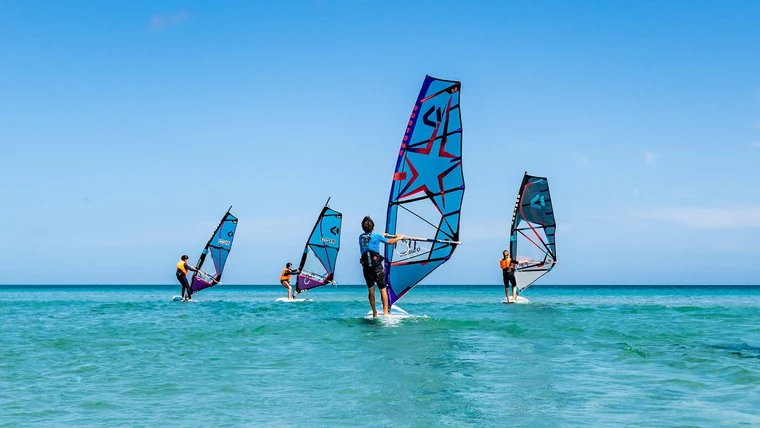
Playa de Sotavento sits on the south-east coast next to Costa Calma, in the municipality of Pájara, and it is not one beach but five — La Barca, Risco del Paso, Mirador, Malnombre and Los Canarios — running about nine kilometres in total. The official portal tags the whole stretch as year-round, calm-watered and windy at once, which is exactly the combination a beginner is looking for.
It calls it one of the best windsurf spots in the Canaries precisely because it holds two things at the same time: a very safe zone for beginners and a zone by the main breaking wave for people who no longer need one. The bottom is sand and the wave usually breaks left, very close to shore.
Matas Blancas, the beach in the bay just along from Costa Calma, is where the same portal sends people who are starting from zero, children and adults alike, and it names March to August as the season for it. Between the two you have a coast built for a first week rather than a first photograph.
Matas Blancas has a school of its own: a semi-private kite lesson for two is €140 per person for two hours, a windsurf taster €60 per person for two hours in a group of three to five, and wing-foil is taught as a private hour at €110.
Sotavento is also a World Tour address, and it is worth being precise about which tour. The PWA Fuerteventura Grand Slam — windsurfing — ran here from 17 to 26 July 2026, the thirty-eighth edition of an event René Egli started with the Pájara town hall in 1986. The dates move: 18–27 July in 2025, 25 July to 3 August in 2024. If you want to watch rather than sail, take the date for your year from the tour calendar rather than from memory.
The north: Corralejo, Flag Beach and El Cotillo
Flag Beach lies on the dune coast north-east of Corralejo, inside a protected area. The portal describes a wide sandy beach that suits windsurfers of every level, with a well-walled wave breaking along its whole length in many peaks and in different directions, a sandy bottom, and an easy entry into the water even for beginners. Its working winds are N, NW and NE, especially in spring and summer — and, unusually for this island, they work independently of the tide. Schools, rental and repair sit around the beach, the access is off the FV-2 and FV-1, and there is parking by the dunes.
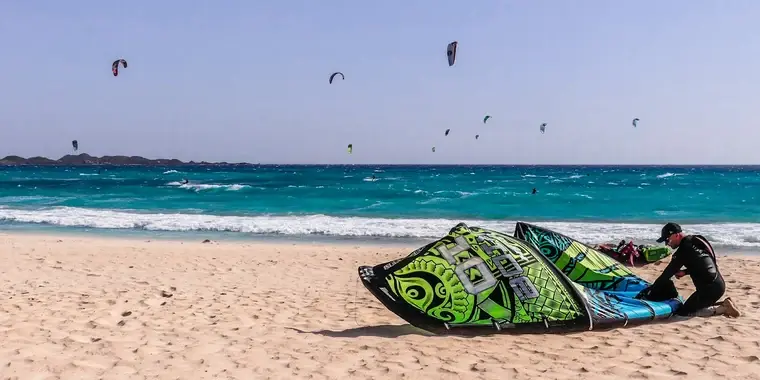
The other northern spots are less forgiving, and they are worth knowing about mainly so you do not wander into them. Playa El Burro in Corralejo is a kite spot where the N–NE trade is more frequent and more regular in summer; the wave is short and left and good for jumping, some preparation is expected even though conditions near the shore will do for learning, riding is advised at low or mid tide, and the volcanic reef is hard on equipment. There are no services there at all, only a car park.
Bristol, on the way out of Corralejo, is for advanced windsurfers only: volcanic reef, a very stable left wave, a winter-and-spring season, and currents at the entry and exit strong enough to drag gear into a dangerous area.
El Cotillo, on the north-west coast, appears on the official portal in two different lists at once — among the places that have kite schools, and among the more demanding spots of the island alongside La Pared. Both are true of the same village, which is why the name of the beach matters more than the name of the town: La Concha, the bay there, has permanently low swell thanks to a horseshoe reef and is watched by lifeguards, while the open beaches of the same village are another matter. The Corralejo schools use the El Cotillo lagoon as their second teaching spot for windsurf and wing-foil.
What a lagoon does that an open beach does not
The structure is simple and it is the whole argument for the south. At Sotavento a sandbar lying 100 to 300 metres offshore encloses a lagoon about three kilometres long. The bar takes the ocean's swell and what is left inside is flat water — the surface you want to fall into forty times on a first day, rather than a shore break that hands your board back at you.
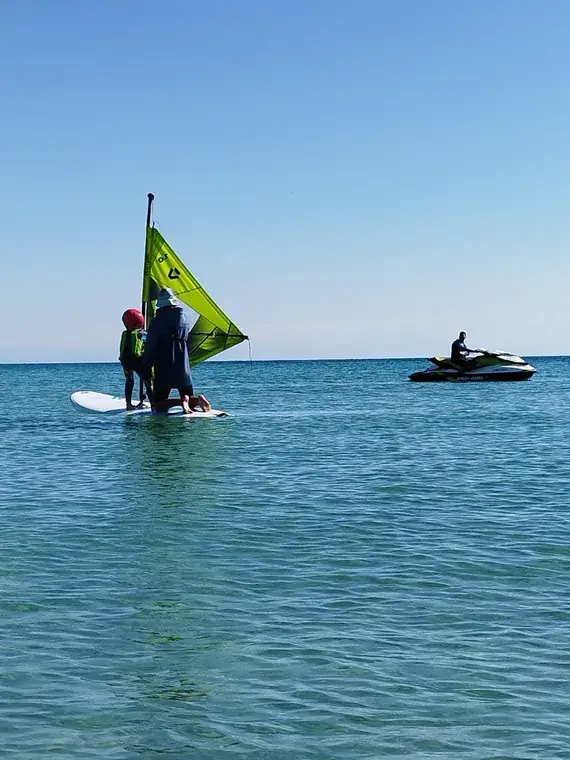
René Egli, whose centre stands on the beach, teaches in that shallow tidal lagoon under an exclusive licence for it, or out in the sea with a jet ski standing by, and runs a free shuttle to the deepest parts of the lagoon.
The word in that sentence to take seriously is tidal. Tides here are semidiurnal — two high waters and two low waters a day — and the official portal writes that at low tide Sotavento gains so much territory that enormous pools appear. In the island's ports the Instituto Hidrográfico de la Marina predicts a daily range that swings from about 0.55 m at neaps to 2.68 m at springs.
Those are figures for Puerto del Rosario and Morro Jable, not measurements taken in the lagoon; nobody publishes a depth for the lagoon itself, and any website that gives you one in centimetres is guessing. What they do tell you is the size of the effect, and why the school, not the forecast, will tell you when your session starts.
The north answers the same question differently. Flag Beach works independently of the tide, which is the practical reason a northern course can be timetabled at ten in the morning five days running; El Burro is ridden at low or mid tide and Bristol on low water. One more thing applies to both coasts: the portal warns that restrictions are in force on part of the island's beaches, for the safety of swimmers and the protection of nature, and that the rules are specific to each beach — the school launching you is the one to ask.
Lagoon structure, tide behaviour on the beaches and the beach restrictions: the island's official tourism portal, read 7 September 2026. Tidal range: tide predictions of the Instituto Hidrográfico de la Marina for Puerto del Rosario and Morro Jable, a 30-day sample from 7 September to 6 October 2026, read 7 September 2026 — an astronomical forecast for one lunar cycle, not a multi-year norm, and weather shifts the real level. Teaching arrangements and the licence for the lagoon: René Egli, read 7 September 2026.
Kite, windsurf or wing-foil — which one first?
The three sports are taught side by side on both coasts, and the schools' own course plans say more about what you are signing up for than any description of the feeling does.
| Sport | Where the lessons happen | Age and weight the schools state | How the first hours go |
|---|---|---|---|
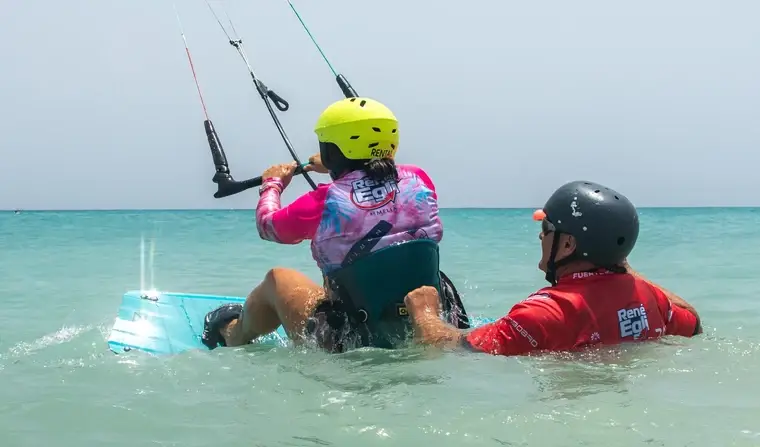
| Kitesurfing | Sotavento: the tidal lagoon or the sea with jet-ski support. Corralejo: a day on Flag Beach, then water lessons from the school's boats | René Egli: from 15 years and 50 kg. Flag Beach does not state a limit on its kite page — ask when you book | Theory, then the kite on the sand. At Flag Beach the one-day course includes no water time at all, and the school says so outright |
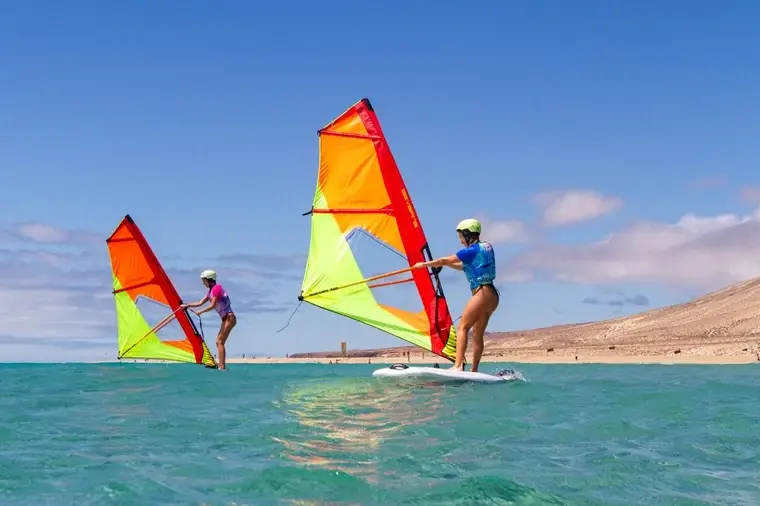
| Windsurfing | Sotavento: the lagoon or the sea. Corralejo: Flag Beach and the El Cotillo lagoon, with a pick-up from your accommodation on day one | René Egli: from 8 years, with a separate children's course for ages 8 to 12 | Rigging, the simulator, balancing on the board — and you are in the water on the first session |
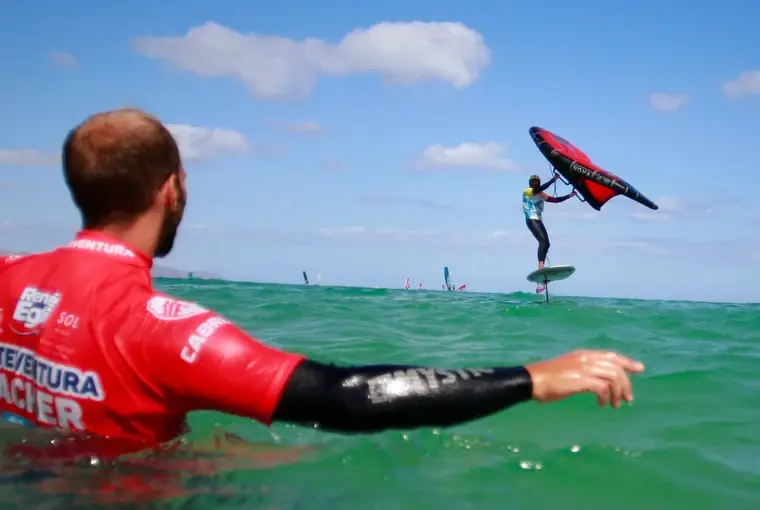
| Wing-foiling | Sotavento: on the sea with jet-ski support. Corralejo: Flag Beach and the El Cotillo lagoon | René Egli: from 15 years and 50 kg | The two hard parts are separated. Flag Beach teaches the foil on day two behind a boat, water-ski style; at René Egli the foil first appears at level F1, after wing control on a board with a dagger-board |
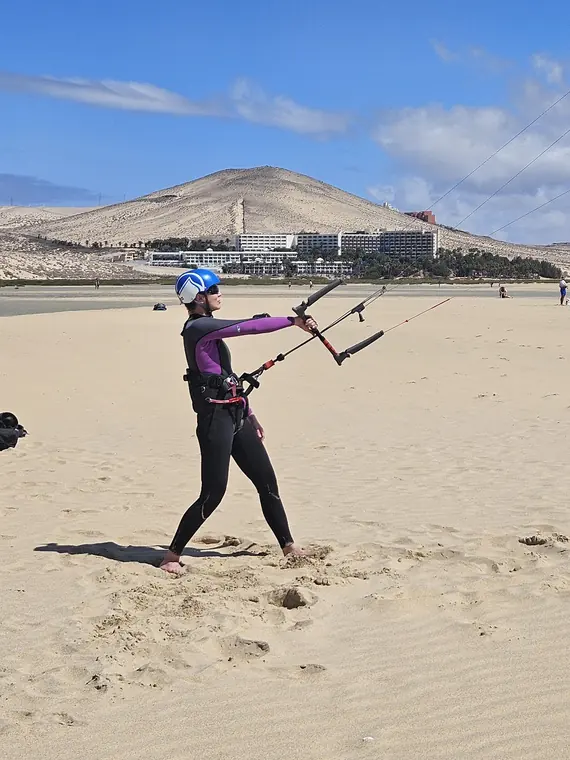
Read down the last column and the choice makes itself. Windsurfing puts you on the water on day one and is the only one of the three taught to children here. Kiting spends its first hours on the sand because a kite is dangerous before it is fun, which is why the single day sold in Corralejo is a beach day by design. Wing-foil is the newest and the most deliberately staged: the wing and the foil are learned apart before they are put together, on day three in the north and at level F1 in the south.
Taster, course, private lesson or rental?
Before the numbers, the unit — because this is where most people misread a kite school's page. A course price is a package of hours or of days, not the price of an hour. René Egli sells kiting in blocks of three hours: 3 h €205, 6 h €395, 9 h €585, 12 h €750, each figure per person and with two students to an instructor. Flag Beach sells days: €175, €285, €395, €485 and €570 for one to five.
What the Flag Beach list does not say is the words "per person", while it does state four students per instructor on the beach and two in the water — so if you are booking for two, confirm at the office how the second participant is charged before you plan a total. The same caution applies to the windsurf table at René Egli, which is headed simply "prices on site" where the centre's kite and wing tables both say "p.p.".
| Format | Where | Price |
|---|---|---|
| Windsurf taster, 2 hours, group of three to five | Matas Blancas | €60 per person |
| Wing-foil group taster, 1 hour | Sotavento | €75 per person |
| Windsurf taster, 2 hours | Sotavento | €85 |
| Windsurf course, 1 day of 3–4 hours | Corralejo | €90 |
| Private wing-foil hour | Matas Blancas | €110 per person |
| Wing-foil course, 1 day of 90 minutes | Corralejo | €120 |
| Semi-private kite lesson for two, 2 hours | Matas Blancas | €140 per person |
| Kite course, 1 day | Corralejo | €175 |
| Kite course, a 3-hour block | Sotavento | €205 per person |
| Windsurf beginner course, 8 hours as 4×2 h | Sotavento | €265 |
| Private windsurf hour | Sotavento | €120 without equipment, €135 with |
| Private kite lesson, 2 hours | Sotavento | €240 without kite equipment, €270 with |
| Hourly rental ticket, 4 / 6 / 10 hours | Sotavento | €90 / €125 / €200 |
Two conditions are worth knowing before you pay. René Egli takes 5% off if the invoice amount is transferred a week before arrival; without the transfer the on-site price stands, and the centre states plainly that every course depends on the weather and on individual progress.
Flag Beach runs a strict no-refund policy with one exception, and it is the one that matters here: its standard beginner and intermediate kite courses of two to five days are refunded if a lack of wind stops you finishing before you leave the island — an exception that does not extend to courses booked inside a package.
What that looks like on each coast
In the south everything happens on one beach. The René Egli kite course in the Sotavento lagoon runs in three-hour blocks from €205 per person, two students to an instructor, with board, kite, wetsuit, life-vest, helmet and equipment insurance in the price, from 15 years and 50 kg. Windsurfing at the same centre starts with a two-hour taster at €85 and an eight-hour beginner course at €265, at most six students per instructor, from 8 years, with a dedicated course for 8- to 12-year-olds at €220.
Wing-foil there is sold as a one-hour group taster at €75 per person or a two-hour private lesson at €240 without wing equipment and €270 with it, taught on the sea with a jet ski standing by.
In the north the day is built around a beach base and a boat. The Flag Beach kite course in Corralejo runs from €175 for one day to €570 for five, four students per instructor on the sand and two in the water, with day one on the beach and the water lessons from the school's boats.
The windsurf course with the same school costs €90 to €360 for one to five days, collects you from your accommodation in Corralejo on the first morning and is taught at Flag Beach and in the El Cotillo lagoon, at most eight students per instructor. The wing-foil course is €120 to €520, an hour and a half a day, with day two spent standing on the foil behind a boat.
Two things sit next to the lessons rather than inside them. Certificates: Flag Beach issues the international VDWS licence — €20 for kite, €40 for windsurf, €20 for wing-foil, book included — and it is what another centre will want to see before renting to you on a later trip.
And practice time: at Flag Beach a complete kite setup is €70 for half a day, €80 for a day and €140 for two, while at René Egli course participants buy an hourly ticket at €90 for four hours, €125 for six and €200 for ten, and there is a supervised Advanced Pool at €160 for three hours, four riders to an instructor, for practising upwind riding once you can waterstart.
Questions that come up before booking
North or south for a first course?
South, if flat water matters most: the Sotavento sandbar encloses a three-kilometre lagoon and holds the swell off. North, if the tide worries you: Flag Beach works independently of it, and the schools there pick you up in Corralejo. Both teach all three sports.
Is it true that it blows fifty knots?
Exceptionally, at Sotavento, as a peak. The monthly averages at the airport station are 17.1 to 25.9 km/h, about 9 to 14 knots, and on the spots the afternoon is stronger than the station. Size your gear against the average, not against the record.
Can the tide stop a lesson?
It reshapes it. Sotavento is a tidal lagoon: at low water the portal describes huge pools appearing, and the school runs a free shuttle to the deepest parts. In the ports the daily range swings between roughly 0.55 m and 2.68 m. The school sets the hour, not you.
Is the course price per hour or for the whole thing?
For the whole thing. €205 buys a three-hour kite block at Sotavento, €175 a day in Corralejo, €265 an eight-hour beginner windsurf course. Matas Bay marks its prices per person and René Egli does so in its kite and wing tables; where the words are missing — Flag Beach, and René Egli's windsurf table — confirm at the desk how a second participant is charged.