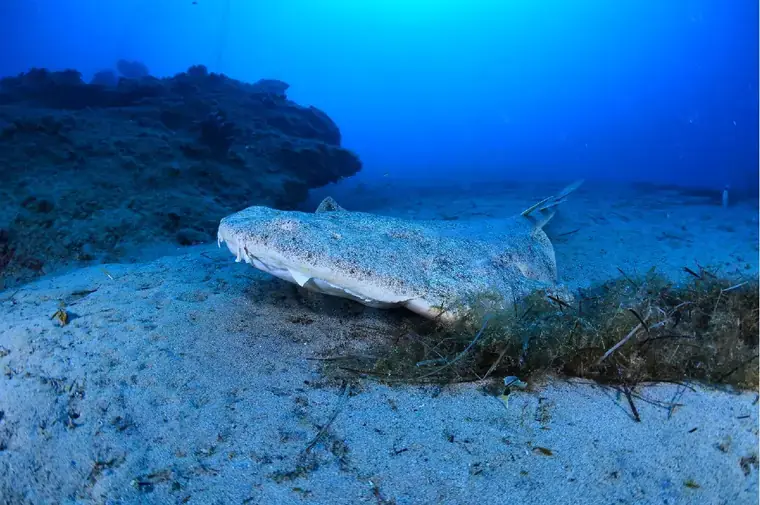
Two questions get asked at a dive shop on Fuerteventura, and only one of them is about money. The other is about a fish: a flat, sand-coloured shark that lies buried with only its eyes above the grain, and that has disappeared from almost every sea it used to live in — except this one.
- What the angel shark is, and why the Canaries are called its last refuge
- Why nobody will promise you a sighting, and what the dive centres actually say
- What a first dive costs here, and what the law caps it at
- How diving is priced on this island — per person, per dive, before tax
- What the price does not contain: equipment, insurance, the tax
- North or south: Corralejo and Lobos against Morro Jable and the Jandía coast
What follows is the part that can be checked — the status of the species from the people who assess it, the practical side from the operators' own pages, and a clear line between the two.
What is the angel shark, and why the Canaries?
It is a shark that lives flat on the bottom, and it is running out of bottom to live on. The IUCN's shark specialist group, writing from Las Palmas in 2016, put it plainly: Squatina squatina is Critically Endangered, it has gone from most of its historic range — the north-east Atlantic and the Mediterranean, from Scandinavia to north-west Africa — and its last populations can be seen only in the Canary Islands, which the group calls the species' last known stronghold.
That is also why the archipelago has a plan for it. A workshop at the University of Las Palmas de Gran Canaria in June 2016 produced a Conservation Action Plan for the angel shark in the Canaries, drawn up together by the Canary government, the national government, divers, scientists and conservation organisations, with a sightings database that divers are asked to feed. It makes a holiday diver here something slightly unusual: a witness. The etiquette follows from that — look, do not touch, do not chase, and tell the guide what you saw.
So will you actually see one?
Maybe. Nobody sells it as a certainty, and the wording the operators choose is worth borrowing. Fuerteventura Buceo, which dives the Veril de Jandía out of Morro Jable, names the angel shark among what its divers meet "with some luck" — the same phrase it uses for its snorkelling trips. Luck is the honest unit here.
The calendars that exist belong to dive centres rather than to surveys, and they do not quite agree. Punta Amanay in Corralejo answers the question in its own FAQ: if you are looking for angel sharks, come between November and February. Dive Pro Fuerte, which walks its divers in from the shore at La Lajita in the south, names November to March instead. Punta Amanay's answer sorts the rest of the year by what it is good for — spring for visibility and active fauna, summer for the warmest water, September and October for the calmest sea. Read both as what they are: the working experience of people who are in that water most days, and not a published study.
So the sensible way to book is to buy the dive for the dive. The wall, the lava and the sand are there in any month. An angel shark on the bottom is the day you talk about afterwards, and it is not a line on the programme.
Can you dive without a certificate?
Yes, in three different shapes. Out of Morro Jable, the try dive with Fuerteventura Buceo is €105 per person before the 7 % IGIC, with the full equipment and the insurance inside that figure. It is made from the centre's boat rather than off a beach — about forty minutes underwater, about ninety minutes from leaving the port — and it starts at ten years old.
Twelve metres is the legal ceiling for a try dive in Spain, and two metres for children up to twelve; the centre adds that it prefers to stay a little shallower, because the deeper you go the faster the tank empties and the shorter the dive gets.
In the north the shallow end is shallower still. Peter Diving at Isla de Lobos starts from €89 for about three hours: the cylinder stays on the surface on a float and a hose brings the air down to you, so nothing goes on your back, and the maximum depth is six metres. It also starts at ten — two years below Punta Amanay's own minimum for scuba in the sea — and the instructor takes two people down at a time while the rest of the family snorkels or waits on the boat.
One caveat on dates: the centre's experiences listing marks this one available from July until November, so confirm before you build a winter week around it.
Between a taster and a licence sits the SSI Basic Diver course, from €135 for about six hours: theory online before you arrive, skills in the centre's own heated indoor pool, then a dive of six to twelve metres at Lobos. Equipment rental and diving insurance are inside the price, and you leave with a certificate that lets you keep diving for six months as long as a diving professional is with you. From twelve years old.
The paperwork is the same everywhere and takes a minute: a health questionnaire and a signed declaration, with a medical certificate needed only if an answer flags something — Punta Amanay cites decree 550/2020 for that questionnaire. And do not book a flight for the same day. That centre asks for at least twelve hours after diving, and twenty-four if you have been diving several days in a row.
And if you want a card at the end of it
The SSI Open Water Diver course in Corralejo runs from €460: four days, four dives around Lobos, theory and pool work, rental of the full equipment, diving insurance and the international certification. The centre lists a longer version, Open Water Diver Plus, at €525, and a shorter Scuba Diver at €265. In Morro Jable the ladder is PADI instead — Scuba Diver at €275 and Open Water Diver at €420, both before the 7 % tax.
What those days actually contain, hour by hour, is written out for the same course on the neighbouring island: PADI Open Water in Gran Canaria, three days. The structure of the course travels; the prices and the dive sites do not.
What is actually in the price?
The most misread number on this coast is €45. It is per person and per dive — the centre states it in exactly those words — so a two-dive morning on the Veril de Jandía is two lines and €90, not one line and €45. The rate falls to €40 a dive from the fifth dive and to €35 from the ninth, and the scale counts dives rather than days. Each dive covers an inspected 12-litre tank, weights, the ride out to the boat and a certified guide in the water. The boat itself carries no supplement: the price list says so in a line of its own.
What sits outside that figure is three things. IGIC at 7 %, which the price list marks as not included. Equipment rental — €15 a day for the full set with a dive computer, €6 for a single piece, €7 for a computer on its own. And international dive insurance, which the centre calls mandatory, from €7 for 24 hours through €15 for a week and €20 for a month to €35 for a year.
| What you book | Where from | Price as published | Inside the price | Certificate and age |
|---|---|---|---|---|
| Try dive, to 12 m | Morro Jable | €105 per person, 7 % IGIC extra | Equipment, insurance, instructor, boat | None needed, from 10 |
| Peter Diving, to 6 m | Corralejo → Lobos | from €89 — ask what the unit is | Boat, instructor, equipment, insurance | None needed, from 10 |
| SSI Basic Diver, 6 h | Corralejo → Lobos | from €135 — ask what the unit is | Theory, pool, sea dive, equipment, insurance, certificate | None needed, from 12 |
| Guided dives at Lobos | Corralejo → Lobos | from €50 — ask what the unit is | Boat, tank and weights, guide | Licence required, from 12 |
| Boat dives on the Veril | Morro Jable | €45 per person per dive, 7 % IGIC extra | Tank and weights, transfer, boat, guide | Licence required |
| Guided snorkelling, 2 h | Morro Jable | €40 per person, 7 % IGIC extra | Guide, full kit, drinks and snacks | None needed, all ages |
| SSI Open Water Diver | Corralejo → Lobos | from €460 — ask what the unit is | Theory, pool, four dives, equipment, insurance, certification | None needed, from 12 |
Punta Amanay in the north prices differently. Its guided dives at Lobos start from €50, and the page prints that figure without saying whether it buys one dive or a day of them, so ask before you pay. Included are the boat trip out, a 10- or 12-litre tank of air or nitrox with weights, and a certified guide. Not included: equipment rental — which the centre supplies to its own divers only — and diving insurance, which it says decree 550/2020 requires of anyone diving recreationally in Spain.
The habit worth keeping is simple. The number in the window buys water time; tax, equipment and insurance are three further lines, and across a week of diving they are the difference between a rough estimate and the real one.
North or south: Corralejo or Morro Jable?
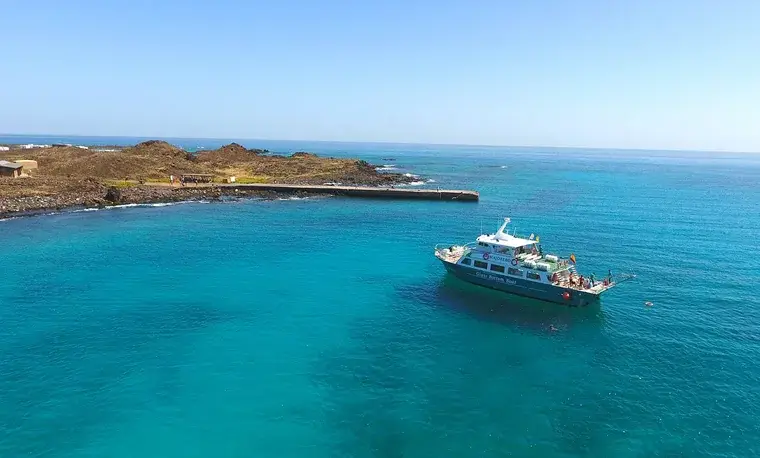
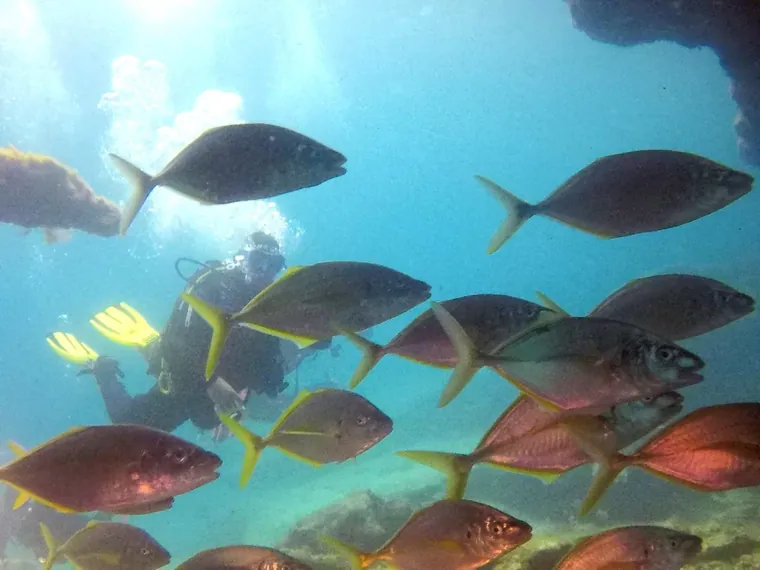
The two ends of the island give two different days. In the north, Punta Amanay dives the water around Isla de Lobos, the small volcanic island in the strait towards Lanzarote; the centre counts more than twenty sites there, from six metres to over forty, over white sand and lava formations. Departures are at 08:30 for more experienced divers and 10:30 for certified divers of any level, and because the boat comes back to the centre in between, one dive or two is your own choice. Reckon on about three hours.
Two details save an argument at the quay. The boat dives around Lobos but never lands on it and cannot drop anyone off there — walking on the islet is a separate trip, with the free Cabildo permit that has been required since January 2019. And the boat is a rigid inflatable rigged for diving, with few seats and those reserved for divers, so a non-diving partner is not coming along for the ride.
In the south, Fuerteventura Buceo goes out of Morro Jable on its own boat at 09:00 and 11:00. The first dive of the day is always the Veril de Jandía, the drop-off the centre describes as deep and still open to every level; the second is somewhere else along that coast, chosen for the group. Between them the boat is the comfort: hot-water showers, a toilet, a dry area for your things and a coffee service.
The one depth the centre publishes for that coast belongs to the Canyon west of the port — fourteen metres at most — and the rest is agreed with the guide at the briefing. From the same boat, a guided snorkelling trip costs €40 per person for about two hours, one of them in the water.
In practice your hotel makes this choice. The island's tourist board puts the airport 39 km and about 40 minutes from Corralejo, and 84 km and about an hour and a quarter from Morro Jable, with taxi fares it calls approximate — €40–50 to the north, €85–95 to the south. Diving is a morning activity at both ends of the island; an hour and a quarter of driving before a briefing is not.
When should you come?
The water here is cool and stays that way: roughly 18–23 °C the whole year round, coldest in February and March, warmest in September and October. The practical translation is the one Punta Amanay gives in its own answer about kit — 5 mm in the summer months, 7 mm or a semi-dry for the rest of the year. If you rent, it comes with the daily set; if you bring your own, bring the thicker one.
Winter has an argument of its own that has nothing to do with any animal. The trade wind that governs everything on the surface of this island is at its quietest between October and January — around 17 to 19 km/h in the monthly averages at the airport station, against 25.9 in July — and the same dive centre calls September and October the calmest sea of the year. Put its November-to-February answer about angel sharks next to that, and a week of diving in midwinter stops looking like the off-season.
Questions that come up before booking
Will I see an angel shark?
Maybe, and nobody will promise more than that. Fuerteventura Buceo words it as "with some luck". Punta Amanay's FAQ sends divers who came for the species to the months from November to February — its own experience in that water, not a published study. Book the dive for the dive.
Is €45 the price of a morning's diving?
No. It is per person and per dive, so two dives in a morning are €90 — before the 7 % IGIC, before equipment rental and before the insurance the centre calls mandatory. The rate drops to €40 a dive from the fifth and to €35 from the ninth.
How old do you have to be?
Ten years for the try dive in Morro Jable and for Peter Diving at Lobos; twelve for scuba in the sea with Punta Amanay and for its courses. A try dive is capped by law at twelve metres, and at two metres for children up to twelve years old.
Do I need a permit to dive at Isla de Lobos?
Not for the water around it: the dive boat never lands on the island. Setting foot on the islet needs the Cabildo's free permit, required since January 2019, and that is a separate trip with its own booking.
Updated 7 September 2026. Prices, inclusions, ages, depths and departure times come from the operators' own pages; the conservation status of the angel shark and the Canary action plan from the 2016 statement of the IUCN's shark specialist group. The Morro Jable centre states IGIC of 7 % as an extra on all its prices.